

Francesco Dondina
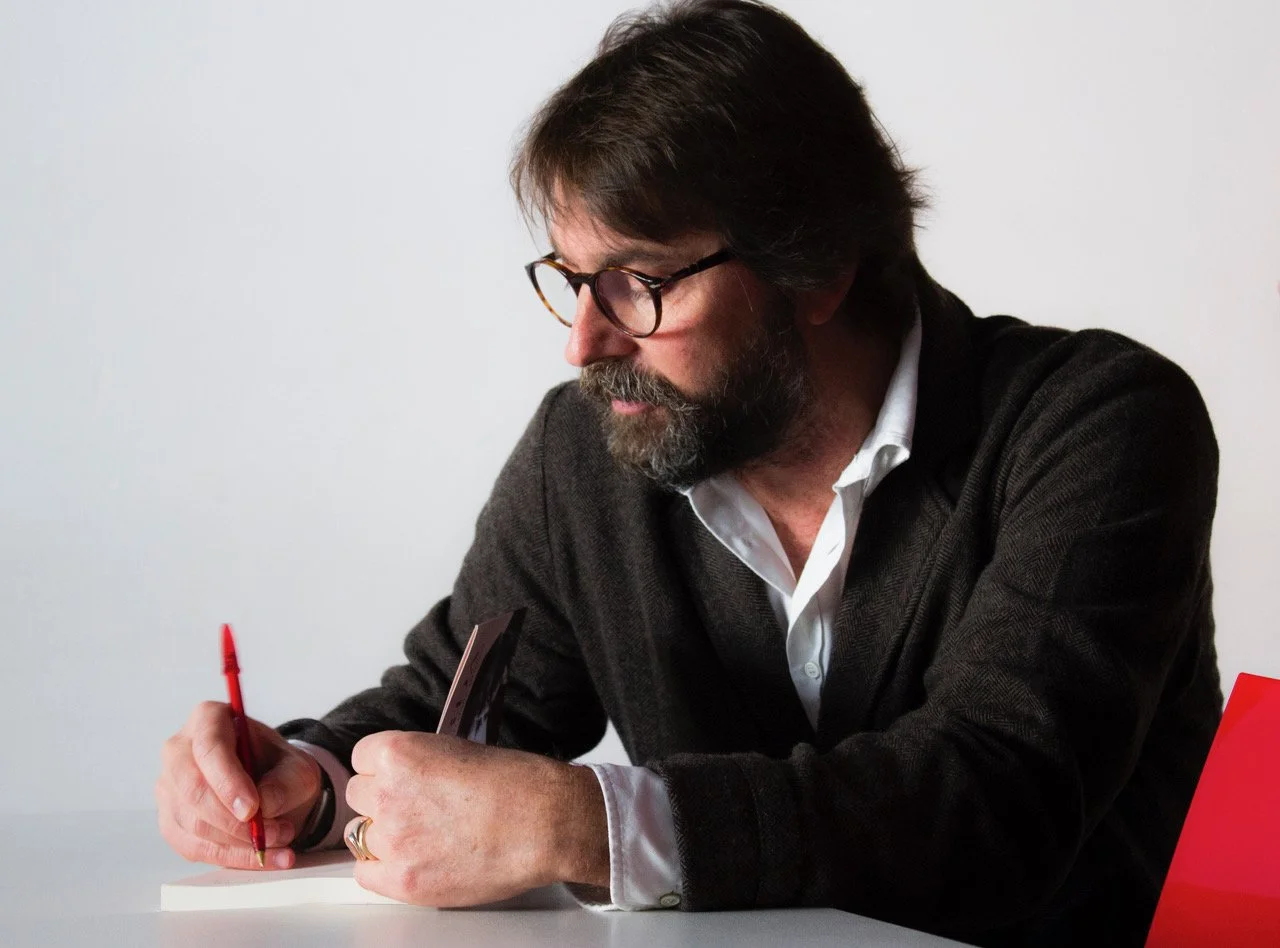
Stranger #19
Francesco Dondina, visual designer, creative director, teacher, curator and Founder of Dondina Associati.
I grew up studying design in Milan, so the name of Francesco Dondina was never far away. Founder of the homonymous studio and a longstanding presence within the Milanese design scene, Dondina describes himself as a static traveller, a navigator of eras who has remained in the same place while the world transformed around him. It’s a definition that perfectly reflects his way of observing the contemporary: deeply rooted in Milan, yet always open to cultural, social and visual change. Our conversation moved through design, Milan, its history and the events that shape the way we think, work and live. He speaks about revolutions with elegance and about younger generations with genuine admiration for their freedom, their courage to experiment and their ability to challenge established systems. Above all, this is a conversation with someone who still believes in the social power of design, as a practice capable of moving consciences and creating cultural change.
How would you introduce yourself?
I would describe myself as someone who comes from other worlds. I was born in the 1960s and grew up through a series of cultural, political and social transformations in Italy that deeply shaped both my life and my work.
In 1970s Milan, my generation was directly touched by a time of intense conflict. Then, in the 1980s, another shift changed everything: mass culture and technology began to redefine the way we lived and saw the world.
My background is humanistic rather than technical. I entered graphic design at the very end of its analog era, when the profession still had a strong artisanal dimension. At the time, the International Style was dominant, with figures like Bob Noorda and Massimo Vignelli as key references. The arrival of new technologies marked a radical break. I suddenly found myself in a completely different landscape, disorienting, yet exciting and full of possibility. More broadly, the rationalist culture of the modern movement gave way to postmodernism, which introduced new languages and perspectives. In Milan, this shift was especially visible. Experiences like Fiorucci stood out as unique cultural phenomena, shaping a new visual language and entire lifestyles, opening up new ways of experimenting and expressing identity.
I think of myself as a navigator, someone who has moved across different worlds and eras while remaining in the same place. I have always lived in Milan and haven’t traveled much physically, but I have traveled extensively through time, through my city and through the people and experiences I’ve encountered.
You are known as a visual designer, educator and curator, as well as the founder of Dondina Associati. What have been the key moments that shaped your professional path?
Nothing in my path was ever planned. What I’ve done didn’t happen by chance, but through a series of combinations.
My background is humanistic, I didn’t study to become a graphic designer and at first I didn’t even imagine I would. Since childhood I’ve had an artistic inclination, leaning towards drawing and illustration, but I studied law, also due to family expectations. I was good at it, but I realised it wasn’t part of my DNA. At a certain point, I had the opportunity to change direction and return to something closer to who I am.
When I entered the world of graphic design, I started from scratch, learning the profession on the job. It was the end of the analog era and we were still working with tools and techniques that are no longer used today. Theoretical knowledge came later, largely self-taught. This non-linear path has defined me. I’ve never had a specialist approach, I move across different fields, and this is reflected in my way of working, which is open and free. I haven’t had mentors in the strict sense, except for those I chose as references.
Over time, other roles emerged naturally. I taught for thirty years, but I strongly believe in generational renewal. My generation can contribute, but it’s important to make space for younger people. Curating also came almost by chance, starting in 2015 with a series of talks in Milan built on a very simple idea: inviting interesting people to speak about graphic design. From there came other projects, exhibitions and the idea of a festival.
I like to think that I wear different hats, depending on what I’m doing. It’s something that enriches me, also on a human level. It allows me to move across different worlds, meet different people and stay curious.
And your studio?
I founded the studio quite early, in 1986, with a partner. The first years were intense and closely tied to fashion and culture. We worked with designers such as Giorgio Armani, Moschino and Valentino, as well as on music projects like the Milano Suono festival. In 1996 we went our separate ways and I continued on my own, maintaining a structure similar to what it is today. It has grown, but it has always remained a studio, I never wanted to turn it into an agency.
Over forty years, what has changed most are the people. There has always been a generational shift, which also reflects a cultural and linguistic evolution and that’s essential. At the same time, we are still recognised for a certain way of doing graphic design.
What has been the greatest challenge in your career, and how has it shaped or influenced you?
Perhaps it comes down to attitude. The greatest challenge for me has been to hold on and adapt, to recognise each time that the world was changing.
As you reach a certain stage in life, both in age and experience, it’s natural to compare yourself with peers of your own generation and look back at the graphic design of the 1970s, with the risk of falling into nostalgia, into the idea that “things were better before.” At some point, you realise that this isn’t the case, because the world is constantly evolving.
This attitude has also been deeply influenced by my personal life because I’ve always lived my family life very actively. Today I’m a grandfather of four and a father of three, and through them change is something daily, impossible to ignore.
So the real challenge has been understanding that you have to adapt. The ability to adapt is the greatest resource we have to move forward. At the same time, from a professional point of view, the challenge is also to remain true to who you are. Each of us is the sum of our experiences, the people we’ve met, and what we’ve done and received and that should not be lost.
To give an example, some time ago an agent of mine in the United States suggested that I should appear more contemporary, less like an “Oxford professor,” perhaps by wearing a cap and a hoodie. I told her that I do feel that spirit inside, but it’s not my way, I’d rather wear a jacket. We may not need to change outwardly, in our tastes or habits, but we do need to change internally, in the way we relate to others. In this sense, the greatest challenge remains the ability to adapt.
What is your approach and how has it evolved over time?
My approach to projects has, in essence, remained fairly consistent over time. An important figure for me has been Bruno Munari, whom I met and had the chance to be in contact with, although not as a direct teacher. His influence came mainly through his books, which I studied in depth and which are still very much part of my DNA.
I like to think of design through culinary metaphors. I strongly believe in research and in the cultural dimension of the process, what we learn every day through reading, experiences, exhibitions and especially by engaging with worlds different from our own. This need to step outside one’s own field is also linked to my non-specialist attitude.
A project always starts from a question, it needs to be understood properly, studied and researched. But it is equally important to keep a certain distance, to read it in an open and non-rigid way. This has always been my approach. At the same time, I trust instinct very much, which over time, it has proven to work well, often suggesting images, directions and intuitions that later turn out to be right.
What has changed the most is the way I relate to others. In the past I was more centralising and self-referential, and I would strongly defend my ideas. Today I am more open, I listen more, both to clients and to my team. I think this has been influenced greatly by the people I work with, as well as by teaching, which has helped me become less rigid. I now feel more free, I no longer need to always be the one authoring or deciding everything. And both personally and professionally, that works better.
During your formative years, graphic design was often closely connected to social themes. What role did it play for you? Do you think it is still possible today to speak of public utility graphic design?
For me, it played a fundamental role. I believe in it deeply, it is an extremely important dimension and, probably, I would not have chosen this profession without that kind of inspiration and attraction.
When I was young and first approached the language of graphic design, I was mainly drawn to that aspect and to the authors working in that direction. Then I was fortunate enough to enter a period when socially engaged graphic design in Italy was at the centre of the debate. Alongside the worlds I mentioned earlier – the modern movement, the International Style, Bob Noorda, Vignelli, and the more “high-end” market-driven graphic design – there was also a strong tradition of socially engaged design. Authors such as Mario Cresci, Giovanni Anceschi, Mario Piazza, Studio Tapiro in Venice and Gianni Sassi in Milan. Gianni Sassi, in particular, had a strong influence on me. Internationally, perhaps the most well-known reference is Milton Glaser, who in his own way also worked within the field of public service design, operating in cultural and social contexts. For me, they were masters, references, great examples.
I still believe that today graphic design as a public service is not only important, but necessary in the path of anyone working in this profession. I would like everyone to always dedicate a part of their practice to this area. If invitations come to work on social, cultural or non profit projects, where you are asked to design a poster, we should do it, even if you’re not paid. It is a small effort that costs nothing. Even for those strongly focused on business, I believe it is a moral, social and political duty. I suppose I belong to the somewhat romantic group who believe that a poster may not change the world, but can certainly shift thinking and move consciences.
I still believe there is space for this and that it is important to continue practising this kind of graphic design.
How do you see the relationship between younger generations and visual communication today?
I distinguish between young people who read graphic design and young people who produce it. I believe that new generations need a language that corresponds to their way of thinking, their world, their culture and their time. I feel this very strongly, also because I am in daily contact with young people.
There is contemporary graphic design that I follow with great curiosity, attention and respect. At times I don’t feel particularly close to it, but that doesn’t really matter, because it is very close to the languages of those who use it, read it, and engage with it. And that is a good thing because the world does not belong to the older generations, but above all to the young. I really like the young people of today, of this contemporary era.
What intrigues or excites you most about the current design landscape?
I’m very intrigued by this courage to break things open. I like the way new generations push languages forward, perhaps even more than my generation ever did.
I’m also struck by their relationship with technology, which feels personal, conscious, and very natural. Technology is an extraordinary tool, but it can become limiting if it is not used with freedom and courage. Every technology has always been a tool in our hands, what matters is how it is used.
It seems to me that younger generations, and the best practitioners in today’s international scene, use technology without fear, without being conditioned by it. It is almost as if it were part of their organism, as a kind of organic relationship.
I’m also struck by their courage in not feeling bound by rigid cultural references, as was the case for my generation. The modern movement we come from was an extremely strong reference point, especially in Milan, almost a dogma. Today, instead, I see figures who move with greater freedom. And I believe that in the future graphic design will continue to be a very open and interesting field to work in.
Let’s talk about Milan and its relationship with design. How would you define it? And how do you imagine its future evolution?
My relationship with Milan, as I said from the beginning, is inevitable, I am Milanese through and through. I grew up here, Milan is my environment, my world. I would say I am a true Milanese at the core.
But Milan has changed dramatically. If we look at it in its physical, architectural and aesthetic dimension, it is a completely different city from the one I grew up in. It has also changed in terms of work, professions, dynamics and relationships. It is a very fast paced city. Some things remain deeply Milanese, tied to its historical culture and I like that, it reassures me and still feels like part of me. Others, however, I like less.
What I don’t fully appreciate is this constant race of Milan, although I recognise its new global positioning. Today it is perceived as a city to go to, a place where things happen. But there is another aspect that concerns me and that’s the risk of it becoming a city for the super rich. The recent Winter Olympics, for example, left large structures especially in the Scalo Romana area that are meant to become student housing or affordable accommodation, but in reality risk being accessible only to wealthier young people. I don’t like that. I would like to see a more rebellious Milan, more critical in this sense. It should not become a kind of dormitory for global billionaires who choose to live here for tax advantages or lifestyle reasons. Otherwise, within ten years it risks becoming an unlivable city, from which everyone will want to leave.
The relationship between design and Milan, however, remains extraordinary, a lot still happens here, you can meet people from all over the world and experience unique opportunities. There are still singular places, such as the Triennale di Milano. This uniqueness is valuable, but we need to be careful, because the constant pursuit of big numbers and visibility should not turn into a kind of circus or “theme park” of design. There is a risk of overload. When everything becomes too much, important issues start to emerge.
In 2015 you launched the “Graphic Design Lectures” series at the Castello Sforzesco, in 2016 the “Signs” project, dedicated to the promotion and research of visual culture in Italy, and in 2022 you organised the first “Milano Graphic Festival.” Different projects, but all driven by the desire to create a space for dialogue on graphic design and visual communication in Milan. If you had to summarise the most significant outcomes of these experiences, what would they be?
Here too I could mention numbers, attendance and participation. We certainly achieved good quantitative results, but what is truly important to me is keeping the community alive and giving space to graphic design, especially to those outside our field, those who are not insiders.
The aim is to bring public attention to what we do and to its role. Underlying everything is the ongoing question of what the role of the graphic designer is today in a constantly changing market. Scenarios change, protagonists change, companies change, communication models change and so do economic dynamics.
The underlying reason, however, remains the same and it is to promote design culture and give visibility to this community and this field. At the same time, I cannot deny that there is also a strong focus on Milan, because I am Milanese and deeply connected to the culture of this city. It is important to remain aware of its history in the field of design and visual communication. Milan has had many masters, many schools founded here and important graphic design archives are located in the city, as well as institutions such as AIAP within the field of visual communication. We therefore represent an important tradition, which should be kept alive without paternalistic attitudes or the idea of being the single global point of reference.
That said, the main focus remains contemporary practice and the new generations, that, in my view, is the real priority.
Is there a project you still dream of realising, but that for some reason has not yet taken shape? If so, what is it?
Absolutely yes. I see it almost as the final project I will take part in, even if I won’t be the only protagonist, but one of those who, if we manage to make it happen, will contribute to bringing a graphic design museum to life in Milan, a home of graphic design.
For someone like me who holds this vision, the idea is to bring together all the experiences built over the years, the talks, the festivals and everything that has been done, into something permanent and stable, a reference point for the world of design and visual communication.
The archives exist, the materials are there, the history is there, the resources are there and the players are there as well. What is needed, however, is a great deal of work to reach this goal. I therefore hope to conclude my career by seeing, if not its full realization, at least the beginning of this project. It is something that, I believe, both Milan and the history of Italian graphic design truly deserve.
Could you name someone who inspires you and you deeply admire?
Today there is a person who, although not young in age, is extremely young in spirit, he’s Armando Milani. He is a very well known designer, still highly active and incredibly curious. He travels, moves constantly and remains deeply present on the international scene.
What I find most beautiful about Armando is that, at a certain point in his life, around the age of fifty, he chose to leave commercial work behind and dedicate himself entirely to public utility design. Today he creates posters, even daily, on the major and minor issues of our time – social, political, public matters, as well as topics related to children, war and other urgent concerns.
He is a close friend and a great source of inspiration.
