

Gail Sorronda
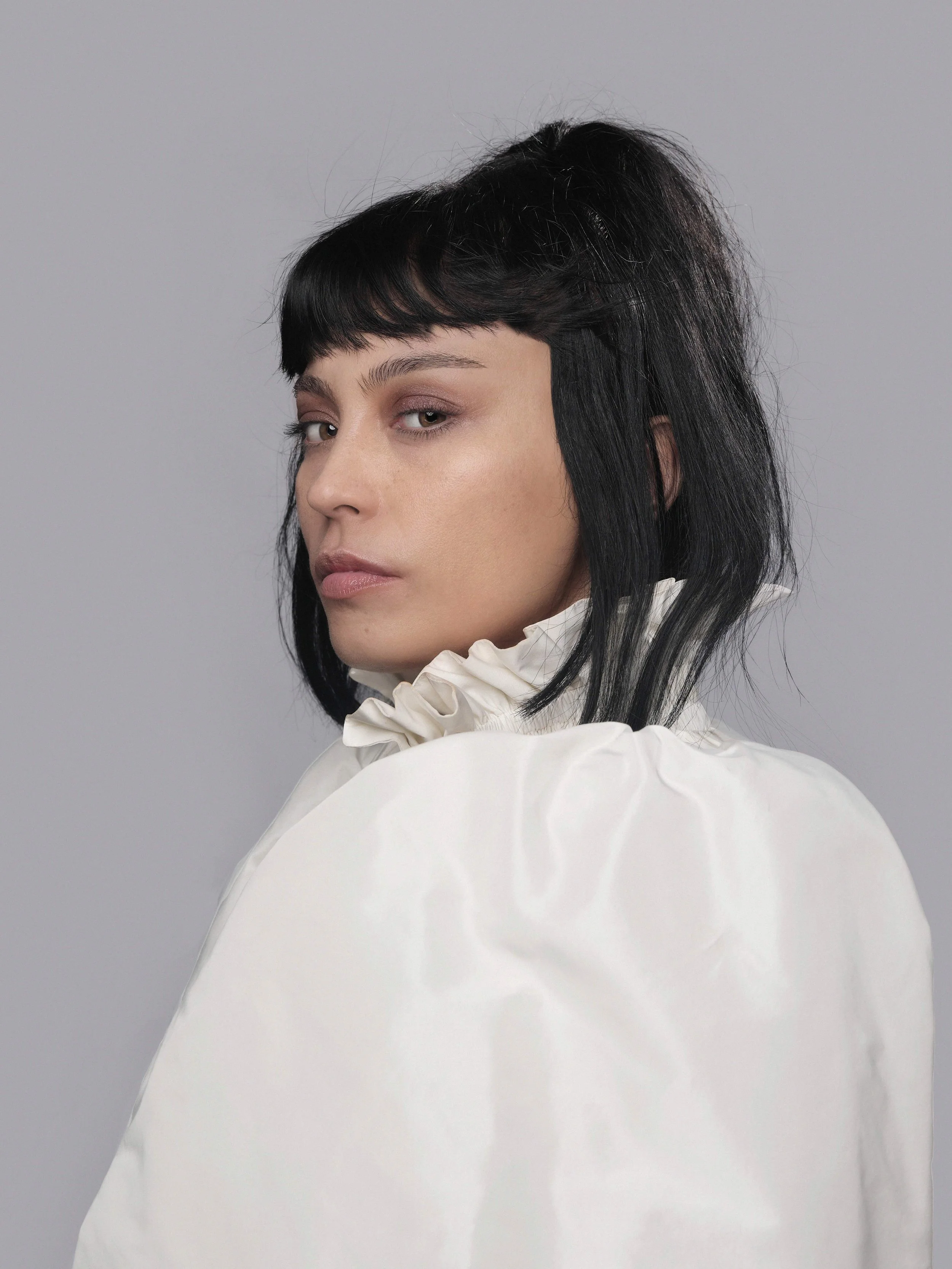
Ph. Georgia Wells
Stranger #12
Gail Sorronda, Fashion designer & Founder of the label Gail Sorronda
I’ve always been drawn to uncovering what lies behind a celebrated artist and their success, and what I discovered with Gail Sorronda is a great deal of sweetness, gratitude, and support –all held together by a kind of blind faith in the universe. Gail is a renowned Australian fashion designer, celebrated overseas by some of the biggest names in the industry. Her journey so far has been an incredible adventure, because she’s someone who, I would say, senses, feels, and leans into the gravitational forces that pull her forward. Trusting and embracing that energy -whether it’s meant to teach you something or bring something positive– is probably her superpower. It allows her to feel grounded in the exact moment she’s in, in the exact place she’s meant to be, fully in charge of her own direction. We talked about creativity as another kind of gravitational pull –something that belongs to all of us, because in the end, creativity is a form of problem solving: finding balance, creating order out of chaos, building something from nothing, and embracing the magic that comes with that. Gail’s connection to the universe is deeply linked to her connection with people, and to her commitment to honouring her own path as a way to inspire others to find the courage to walk theirs too.
How would you introduce yourself?
My name is Gail. I run a contemporary women’s ready-to-wear fashion label called Gail Sorronda. This year marks 20 years in the business. I’m based in Brisbane, where I have a store on James Street, and we also have an online presence.
You’re a renowned fashion designer who has been celebrated by industry legends Karl Lagerfeld and Dolce & Gabbana, and you just marked 20 years with an anniversary show. Could you share the key moments that have shaped your professional journey?
I feel like everything builds upon itself. You can’t always pinpoint one moment –they sort of weave together. Even having my daughter was a key moment. It’s not a “fashion” milestone, but it galvanised me, it made me want to keep going, to share things with her. I always say that’s the ultimate act of creation, for me as a woman.
The first big step was with my graduate collection. I’ve said it a million times: I had my eye on this national competition I’d seen the year before at Australian Fashion Week. I entered with my graduate collection and ended up winning. We were actually the first graduates from that course –the Bachelor of Fine Arts in Fashion Design at QUT. I’d been studying Built Environment, then switched to fashion almost on a whim when the course came up, so we were like pilot students. Winning that competition meant showing at Fashion Week, and from there I started wholesaling to local stores. That’s really how it all began.
But even before that, I always loved making things –problem solving until you find that compositional balance, whether it was jewellery or clothes. While I was still studying Built Environment and Business, I’d make things for myself and sell them in stores. It was just fun, but then it starts to infiltrate your life and you think: why am I not doing this all the time?
I was also offered a space in the old TCB building early on –it was such a generous opportunity. We got to design our own shop, and rent was free for a year. I did that for a couple of years, then went overseas when another opportunity came up. I yo-yoed a bit, back and forth, but about 12 years ago I came back and finally opened my own store. By then I had the confidence –I’d had that “training wheels” experience, but this time it was with full commitment.
There were also serendipitous moments, great recognitions during the journey. When I was overseas, I was a finalist in Who’s on Next with Vogue Italia. That led to being stocked at Dolce & Gabbana’s Via della Spiga store in Milan. I remember being back in Brisbane and getting an email from them –I thought it was spam! But it was real. They gave me a budget to produce an order, and we ended up featured in Italian Vanity Fair as best sellers. It was such an honour, and such a rare opportunity.
So yes, there are these big, shiny moments, but I also think the smaller ones are just as important. I’m a big believer in signs. Sometimes they’re warnings, sometimes they’re encouragements. I feel like you’re always leaning into that energy force, whether it’s meant to teach you something or bring something positive, it’s all part of the journey. Those catalysing moments remind you that you’re in charge of your own direction.
What has been the greatest challenge you’ve faced in your career, and how did it shape you?
I think the biggest challenge is finding the balance between work and life –family life and work. It overlaps, because my husband and I work together, and finding that balance is always a work in progress. That’s a big challenge.
The other one is time. You never feel like you have enough hours in the day. You need to find space to pause, to just chill. The funny thing is I never feel like I’m doing enough –I could always be more productive, I want to multiply myself. And I’m a bit of a control freak, so delegating isn’t easy either.
There are also the creative and financial sides to navigate. Over time we’ve found a rhythm, but there are always question marks. We don’t take unnecessary risks, but we do take calculated ones — that comes with time and experience. We’ve also chosen not to take the usual path. There’s a system at play in the fashion industry, and I don’t think it’s very sustainable. So we try to do things differently. For example, we generally don’t go on sale –we do a small sample sale once a year, but there’s never an excess.
When you look at the bigger picture, you can see how the traditional model has been under strain for a while. The writing was on the wall. Big marketing campaigns and mass consumption have trained people to shop a certain way. Instead, what we focus on is growing a community, being present, serving our customers, and getting to know them over time.
Some of my customers have been with me since my graduate collection, which is really special. Many of them feel like a kind of matriarchy, supporting me over the years. I love seeing that, and I love seeing things expand incrementally. There are no big surprises in the way we operate, and that’s nice –especially as a creative.
Let’s talk about your label, Gail Sorronda. How and why did it start?
I think, as I said, it really started from just being busy making things. You see something and think, oh, that would make a nice picture. I remember in school, you’d find something on the road and think it could be interesting –like creating a glass piece from a broken screen at the bus stop, scooping it up and collecting it.
It’s just that compulsion of making things: finding balance, creating order out of chaos, building something from nothing. It’s kind of fun –magical, in a way. You want some security, and I see the world as this big chaos. Making things is my way of finding balance in that chaos, creating a space to set a world in a certain way.
It’s almost like exercising those pathways enough times that it becomes real, something I can build upon. It’s like alchemy –transmitting and creating. I feel people have a natural pull toward certain things, it’s a form of discovery. Not everyone makes it their career, but I think we all have that gravitational pull to explore. Creativity can take so many forms, at its heart, it’s all problem solving.
Why did you decide to use your name?
Sometimes I feel a bit nervous about that, to be honest. But actually, I used my mum’s maiden name, Sorronda, so it wasn’t my birth name –it’s a way of honouring that part of my ancestry. I feel like we’re gifted through bloodlines. Sometimes I think maybe I should just go with Sorronda entirely in the future, to claim back my name in more personal ways. It’s something I think about now and then.
But I also feel it’s good because you can’t hide. Creativity is this balance of stepping in front of your work and hiding behind it –the polarities are real, and it’s natural to flick between them.
Your style has been described as monochromatic, voluminous, and darkly romantic with a Victorian Gothic aesthetic. Where do you draw inspiration from?
It can come from anywhere. Really, it’s about where your interests are. I’ve always been drawn to the esoteric, to history, to the study of religion, and to people. It sounds a little lame when you say it out loud, because you don’t literally see those things represented in a garment you put on. But the feelings are born from somewhere.
Often I’m listening to podcasts or audiobooks while I work, because I’m always chasing time. I’ve kind of trained myself to do that, otherwise the monkey mind starts, and the anxiety creeps in. There are definitely neurodivergent things going on, but I’m embracing all of it. Even when there’s a moment I could relax –say, after a show or the end of a collection– I know that around the corner that creeping feeling will return. And then I have to start building again. It’s a cycle.
Like I said, it’s almost a neurological pathway, like being on a wheel where you’re constantly eating your own tail –which is self-consuming, but also driving me to keep producing. So inspiration comes from anywhere, it’s just a feeling that rises up. Each collection is like a chapter, and you’re waiting for it to reveal itself. Then it overlaps into the next one, and the cycle begins again. The output can take so many forms, but you always set goalposts –almost like forecasting, bridging timelines between the present, the interim, and the future. And when you reach the end, you realise what it was all about.
Everyone has a certain handwriting. I have my style. Maybe I’m in my bubble, but that’s my handwriting.
You once said that the key to success is avoiding distraction, yet as a designer, you’re also highly sensitive to the world around you. How does the world around you influence your work today?
I would just say it’s about finding order out of chaos. When I’m deep in the process, trying to work through an idea, the studio looks like a bomb went off. And before I even get there, I procrastinate – cleaning up, painting the walls white, doing anything but starting. It's a kind of slinky, swinging between extremes, and sometimes the balance feels completely off.
I remember working with a pattern maker in Italy and never really giving him a clear plan. He once said, I don’t know how you do it, but somehow we always end up with a collection where everything fits together. That really sums it up. Somehow, every single time, the pieces come together, and there’s order in the chaos. I still don’t understand exactly how –but I know I can get there.
You’ve steadfastly trusted your instinct and resisted trends and the conventional fashion cycle, keeping your style authentic and unconventional. How does that approach work within today’s fashion system?
I think the system today has space for everybody. You can really do what you want, and if you’re lucky enough to build a rapport with people who connect with your work, that exchange becomes powerful. In this transactional world, their support helps us pay the rent and survive –but it’s also more than that. I get to offer something material, born out of nothing, and in return they pass something material back that allows me to keep creating. That cycle feels really special to me.
I’m also always testing my own boundaries, expanding into new elements, pushing my personal frontiers, or exploring collaborations. You have to stay open to where the energy flows. That’s how I walk my path. For me, it just feels like the natural order of things.
You started in Brisbane, felt the pull of Europe’s energy, but then chose to return home to Brisbane. Could you tell me more about that decision?
I think most young people feel the need to explore what they don’t know –it’s almost a rite of passage. For me, the opportunity arrived naturally. Before opening my shop in Brisbane, I spent a few months in Europe, and I told myself that the next time I went overseas, it would be for work. And that’s what eventually happened. My first work trip was to Paris with Next Management. I remember walking in late with both my styling and modelling portfolios –strangely enough, they chose me because of the styling one. Next had just opened a creative division in Paris, so it all unfolded in this very unexpected way. I even managed to pay for those first trips with early stockist orders, and soon I was working with Kenzo and meeting Nicolas Ghesquière at Balenciaga.
I’ve always had this blind faith in the universe. I do believe in manifestation, though sometimes I wonder if it’s the ego or the soul doing the manifesting. Either way, I’ve learned you’re never fully in control. That first time in Paris, for instance, I realised on my last day that I had no money left in my account –but then, almost immediately, I landed a job in the UK that paid £10,000.
There were also surreal moments, like designing a collection in a haunted apartment in Le Marais. My husband didn’t believe me at first, until he saw a glass literally explode across the room –after that, he admitted something was going on. Once he accepted it, the energy seemed to settle. Paris was chaotic and spooky at times, but also incredibly full, my heart was full. Through chance meetings, I connected with an Italian pattern maker working for Tom Ford, whose mother had worked for Chanel. Suddenly I was manufacturing in Italy and applying for the Vogue competition Who’s on Next.
Eventually, though, I felt the gravitational pull back to Brisbane. Some places resonate and others don’t. I can’t explain it, but I’ve always felt I was meant to come back to Brisbane and build something here.
Brisbane feels unique to me, there’s a future energy here, like something is blossoming. Maybe it’s not even for me, maybe it’s for my daughter in the future. Sometimes you’re just in a place for a reason. Right now, I don’t feel the pull to live anywhere else. Even if I remain mutable, right here, right now, it feels right.
Do you think certain places in the world offer more recognition for a fashion designer than others?
Yeah, for sure. Obviously, some people don’t even call fashion art. In Europe, or Paris, it’s considered an elevated art practice. Whereas in Australia, you often can’t really cross over fashion and art –there’s a line people draw. That comes down to conditioning, how we’ve been taught to perceive things.
Of course, fashion serves a purpose, but then again, so does a painting. Maybe a painting’s purpose is simply to make a wall look better. Your body is a wall too! It feels a bit archaic to separate them. I’m not saying I’m doing the most elevated version of art practice there is, but this is my offering. And for me, the lines between fashion and art are blurry. When you’re in places where it’s embedded in the culture, people perceive it differently.
If you look at the system here –what it supports and what it doesn’t– that’s how you know it’s not viewed the same way. We don’t get help from our government, we don’t get help from local councils. The system doesn’t support it because they don’t believe it holds the same value. It’s unfortunate, but it’s the truth.
That said, things are changing. I think there’s a re-education happening. If you look at Business of Fashion right now, they’re talking about that shift. I’m glad we pivoted earlier on –maybe that was my higher self speaking when I came back to Brisbane and thought, I’ll just do my own thing.
Is there a project you still dream of realising—something that, for some reason, hasn’t yet taken shape?
Yes, I do, but I don’t like to talk about it until it happens, otherwise it feels like I’ve already released the energy and in a way already done it! (laughs)
I also believe that if someone came to me with a really exciting opportunity, there are so many things lying dormant, just waiting. That’s the fun of it.
Now that I’ve built a base, I feel I can take on projects without being completely at risk–and maybe that’s the real achievement. Opportunities come in unexpected ways, and they can shift how you see things. I think there’s real value in walking your own path, because it can inspire others to find the courage to do the same.
For me, your own power is the pivot for everything. I wouldn’t say I’m overly confident or delusional, but I do feel the need to revisit and refine certain moments or projects. Maybe that’s part of the dream too, the desire to keep evolving.
Could you name a person who inspires you or whom you admire?
I’d say Gary Bigeni. I've known him since my university days, about 20 years ago, when I did a fashion assignment on him while he was stocked at my first stockist, Blonde Venus. To this day, Gary has a way of making me laugh –and sometimes that’s exactly what you need!
“Dear Gary,
I’ve known you for 20 years, since when I first contacted you as a student, and we’ve maintained our friendship. What resonates with me about you is how you honour your inner child –your creative spirit shines through and inspires many to embrace playfulness and laughter with unbridled, unapologetic confidence. Your steely will and resilience are also superpowers that I admire.”
