

Armando Milani
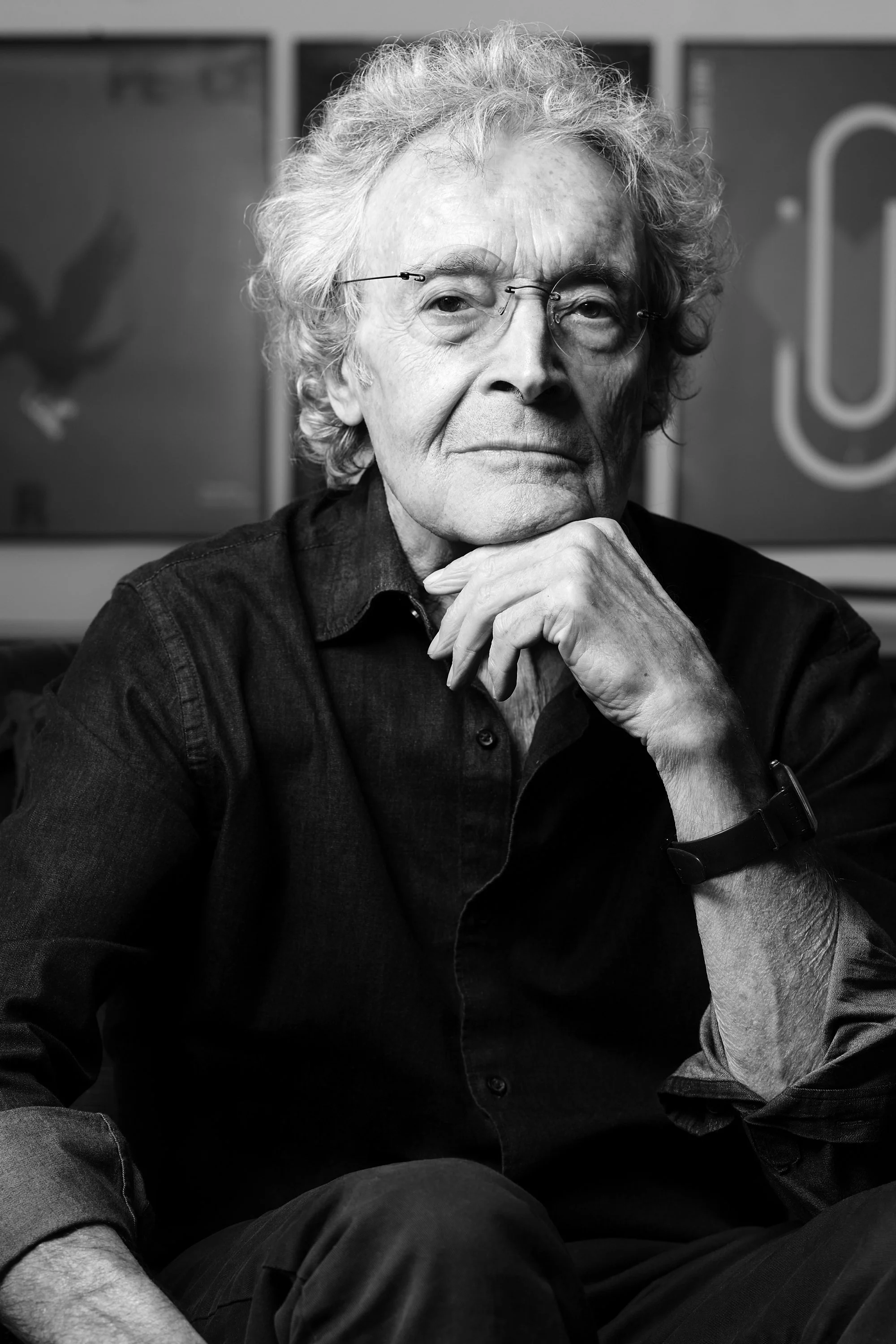
Stranger #21
Armando Milani, visual and graphic designer.
Armando Milani's name came up again and again throughout the Hello Strangers interviews, especially among designers who lived and worked in Milan or New York during the second half of the twentieth century. By the time I had the chance to meet him, I already felt I knew him through the stories of others. Throughout his career, Milani has generously shared not only his own knowledge but also the lessons he learned from some of the most influential graphic designers of his time. His life has been shaped by countless collaborations and encounters, some intentionally sought out as part of his research, while others arrived unexpectedly, opening new opportunities like sliding doors he chose to walk through. During our conversation, he apologised for speaking mostly about his posters. But they are the clearest expression of his way of thinking and of a career built around the idea that humanity itself is the ultimate client. For him, peace, compassion and social responsibility are the highest values that have guided his practice for decades. What fascinates me most about Armando Milani is his ability to communicate complex and often difficult issues with clarity and a touch of irony, as all the best designers do. His posters remind us that images have the power not only to communicate, but also to inspire reflection and action.
How would you introduce yourself?
I’m a Milanese visual graphic designer who has lived through three phases in his career. During the first twenty years, I trained and worked in Milan alongside some of the great designers of the 1960s and 70s.
The second phase was an important experience in New York, where Massimo Vignelli invited me to work with him on projects for major companies such as Lancia. I later opened my own studio there, working with clients such as Olivetti and IBM. During that period, I also worked extensively in publishing and conceived several books. One of them was A Double Life of 80 AGI Designers, born from the idea of collecting photographs of eighty AGI designers in front of businesses that happened to share their surname.
Another important project from those years was No words posters, because I believe in images that speak for themselves, without the need for words. For me, the synthesis of the image is fundamental in communication.
Today I’m finishing a book titled From the eye to the heart, dedicated to posters that are able to communicate instantly through a single image. I enjoy creating connections between my work and that of other designers and artists, as happened with Lawrence Ferlinghetti, with whom I created a book born from the encounter between his poetry and my images.
The third phase of my career began in 2002 with the poster featuring a dove between the words war and peace, taking the letter “a” from war and carrying it towards peace. The work was created for the United Nations. The idea emerged after an experience in Beijing, where I had been invited to serve as a judge for an international competition dedicated to peace. From that moment on, I increasingly dedicated myself to socially engaged posters in defense of women and children, against war, against pollution and so on. Today my client is humanity, a client that does not pay in money, but gives me enormous satisfaction in return.
One of the projects I’m currently working on involves a thirty meter wall in Cyprus that divides the Turkish and Greek sides of the island. I was asked to recreate my dove across the entire wall: a symbol designed to unite rather than divide. On the wall beside it, instead, I would like to leave space for the signatures of anyone who passes by.
What has been the greatest challenge in your career, and how has it shaped or influenced you?
The greatest challenge for me came when Massimo Vignelli, after seeing my work in Milan, invited me to move to New York and work with him. I was thirty five years old, and it meant leaving behind my life, my studio and everything I had built. I also spoke very little English.
I spent six months unable to sleep before finally deciding to go, but today I have absolutely no regrets. In New York I built my family and met great AGI designers such as Paul Rand, Saul Bass, and Milton Glaser, who later became close friends.
What is your approach and how has it evolved over time?
My approach has changed a lot depending on the clients I worked with. In the first part of my career I mainly worked for large companies, developing corporate identities. In that context, it was essential to understand who the client was, what kind of image they wanted to project and what the needs of both the company and its audience were. The designer’s role was to synthesize all of that into a logo and its applications.
Today, instead, society itself has become my client. In this phase I mainly listen to my emotions. Often, while watching the news in the morning, I sketch ideas in my notebook and then collaborators or students help develop them digitally.
I’m not afraid that artificial intelligence will surpass human intelligence, because without human emotion there would be no final result. Artificial intelligence is an extraordinary tool, but I believe the human being must always remain at the center.
During your career you moved from corporate graphics to socially engaged design. Ethics, however, has always remained central to your work. Do you think the same is true in contemporary design?
To answer this question, I have to talk about Albe Steiner, my first great teacher. I was seventeen or eighteen when I saw one of his posters that deeply struck me: a soldier’s helmet filled with soil, with a rose growing from it. It was a simple but incredibly powerful image created for peace.
That poster pushed me to seek him out and later attend his school, the Umanitaria, where I studied with him for three years. That is where I learned what ethics in design truly means. Steiner was able to use the tools of communication and persuasion for social and cultural purposes.
Today there are certainly schools that teach these values, but perhaps there should be more emphasis on them. In my workshops I often speak about the importance of thinking about others. One exhibition that was especially meaningful to me was Ubuntu, inspired by Mandela’s philosophy and the idea that “I am because we are.” To me, everything begins there.
You once said that graphic designers have an obligation to work toward social and cultural purposes. But who is responsible for creating the conditions for this to happen: the designers themselves or institutions?
Institutions play a fundamental role. They should promote awards and initiatives capable of engaging younger generations with these themes. For emerging designers, participating in competitions can be extremely important.
When I was twenty five, for example, I won a prize organised by RAI for the Radio Telefortuna logo. There were nine thousand participants and I came in second place. That experience gave me the confidence to open my own studio. Today I can afford to work independently, but for a young designer things are much more difficult. That is why I believe there should be even more opportunities connected to social and cultural design, especially considering the world we live in today.
For you, the value of images lies in their ability to provoke reflection and move people’s consciousness. What are some of the most unexpected reactions you remember receiving?
One day a designer friend sent me a photograph of my dove poster, enlarged to two meters high, displayed in Berlin’s main square and surrounded by hundreds of peace demonstrators. It was one of the most emotional forms of recognition I have ever received, because it meant that people truly identified with that image. The wall project in Cyprus is also very meaningful to me, because it shows that my work can create a sense of shared identity. Another touching moment was receiving a message from a teacher in Bangladesh asking permission to use my dove image in a booklet about peace created together with his students.
Sense of humor and creativity are essential elements in your visual communication. I’d love to hear more about that aspect.
Absolutely. My book A Double Life of 80 AGI Designers was born precisely from this idea. The sense of humor in that project is very immediate and direct. At first I didn’t have the courage to approach the great AGI designers. Then came what I would call a true “sliding doors” moment, one of those moments where, just like in the film, your life can suddenly change depending on the choice you make. I met Alan Fletcher at the Guggenheim Museum and told him about the project. He loved the idea so much that a week later he sent me a photograph from London in which he was standing in front of a shop bearing his surname. That gesture gave me the confidence to approach all the other designers as well.
I believe the best designers are those capable of laughing at themselves. Paul Rand even wrote the introduction to the book, speaking precisely about the importance of sense of humor. For me the ability to approach life with irony and lightness is fundamental.
Sense of humor is not expressed through loud laughter, but through a smile and in this, the English are particularly brilliant.
Milan and New York are two fundamental cities in your personal and professional journey. What did each of them give you?
Milan gave me my education and the most important encounters of my career. It was there that I met figures such as Steiner, Confalonieri, Boggeri, but also Magistretti, Sottsass, and Mari. Between the 1960s and 1980s, Milan was an extraordinary place for design.
New York, on the other hand, connected me with the great international AGI designers and taught me how to be pragmatic. When I first arrived, I was very much a dreamer. In New York I learned to respect deadlines, solve practical problems, and transform ideas into real projects.
Today my work is the result of the encounter between these two worlds. Through my posters I still try to encourage reflection. In the triptych I created, composed by the dove of peace, the eagle of war, and the hummingbird, the hummingbird represents the action. It carries the letter “A” from speak to react. For me that is what matters most today, moving from words to action.
Is there still a project you dream of realising?
There are two projects that are especially important to me. The first is the archive of my work, which will be hosted at the Triennale di Milano. As someone from Milan, this means a great deal to me. I like the idea that one day students will be able to see these works and continue reflecting on themes that are still deeply relevant today. The second project is my book From the eye to the heart, where I explore the three phases of my life and career. I am writing it now, and although it requires a great deal of work, I want to do it properly.
What advice would you give to a young designer today?
First of all, I would advise them to study the history of graphic design from Toulouse-Lautrec to Russian Constructivism, from the Bauhaus to the Swiss, British and American schools. You must first understand the rules before you can break them.
I would also encourage young designers to read, visit exhibitions, travel, and engage with different cultures. Traveling teaches you that no culture or religion is superior to another. It is through dialogue and exchange that we truly learn how to live together peacefully.
If you had to name someone you admire, who would it be?
There are many designers I would have suggested, but sadly they are no longer with us. If he were still alive today, I would certainly say Albe Steiner.
Thinking of someone contemporary, I would say Katia Pecoraro, a designer friend who is intelligent, sensitive and deeply constructive.
