

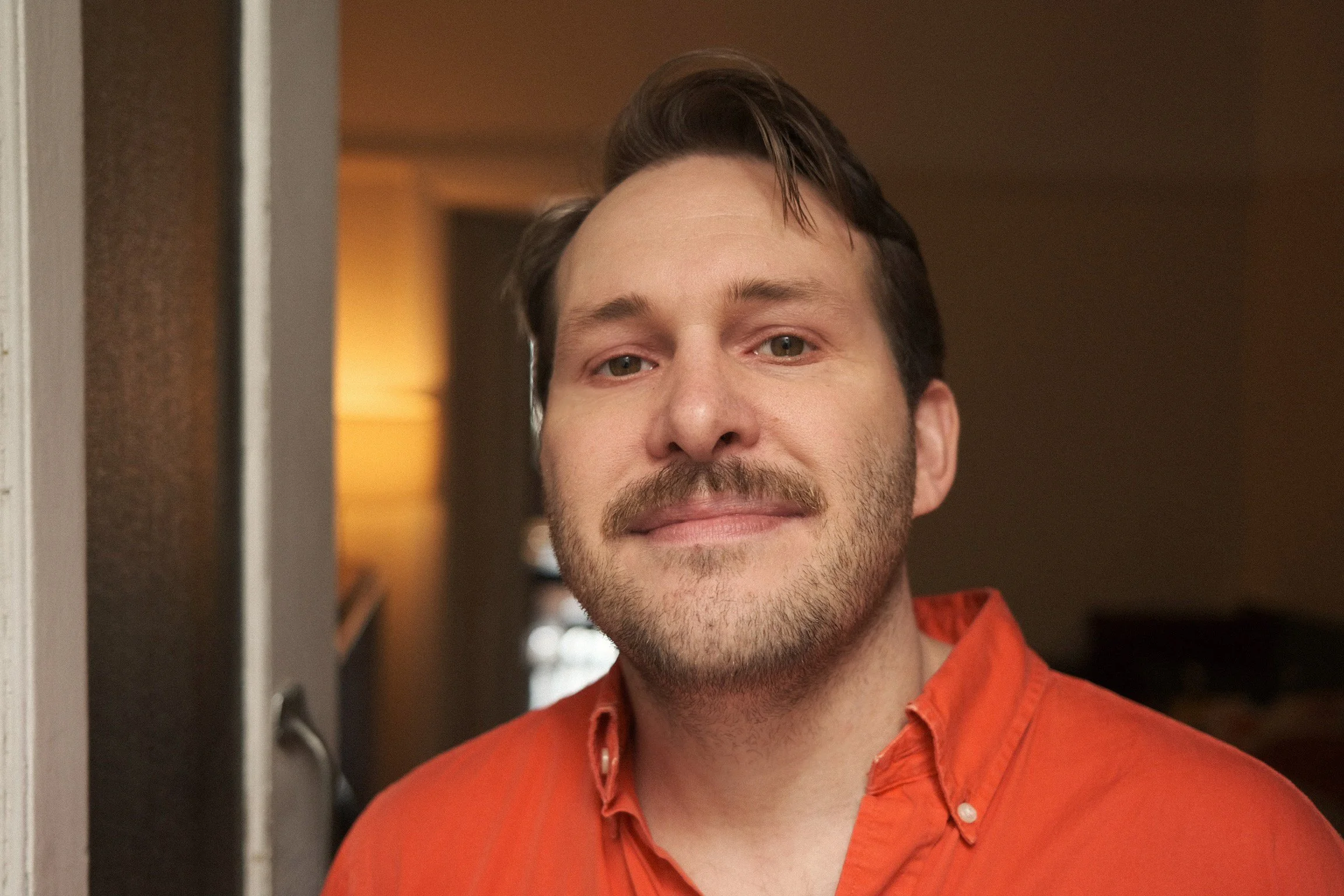
Stranger #22
Michael Hankin, Set and costume designer
When Gary Bigeni suggested I interview a theatre set and costume designer, I was immediately excited to step into a world I have always found very intriguing. Michael Hankin brought me into that world with an enthusiasm that made his practice even more captivating. Growing up on the Central Coast, his curiosity led him into a career spanning theatre, opera, dance and film in Australia and internationally. What fascinated me most was the way Michael thinks about design beyond aesthetics. His approach is conceptual and methodical, but always comes back to the audience, how people inhabit a space, experience a story and share something together. His references move just as freely between worlds, from The Wizard of Oz and opera to the MET Gala, live performances, film, television, painting and contemporary art installations. He seems constantly hungry for what is happening around him, absorbing different languages and bringing them back into his own practice. Perhaps that's why his dream of designing for a stadium or a large arena makes so much sense to me. At the centre of Michael's work is a desire to bring people together, whether in a theatre, an exhibition space or one day an Olympic stadium: to create something temporary that can stay with an audience, open up a conversation and become part of a collective memory. Ultimately, Michael designs spaces for people to inhabit, interact with and share.
How would you introduce yourself?
I'm a set and costume designer working across theatre, dance, opera and film. Design is about establishing a world and finding a visual language for a piece, no matter the form.
In many ways, I'm interested in removing my fingerprints from the work. Ideally, the audience isn't aware that a designer has intervened. With costumes, that often means understanding why a character wears what they wear, their social background, economic circumstances, whether they're trying to stand out or blend in.
Set design is perhaps easier for people to recognise now because there are so many behind the scenes videos showing how films, etc are made. You can watch how a ship was built for Pirates of the Caribbean or how visual effects were created. But what people don't always see is that design is also about meaning, budget, practicality and problem solving. It's about finding ways to weave narrative into every aspect of the storytelling.
For me, it's an intensely collaborative process. I spend a lot of time in conversation with directors, actors, costume, prop and set makers, supervisors and technicians. Everything begins with a concept. In some ways, I think like a conceptual installation artist. I'm often less interested in aesthetics for their own sake than in the ideas underneath the work. It always starts with the script and the story. What are we really trying to say? What ideas sit beneath the narrative? That's where the design begins.
Your work as a multi-award-winning set and costume designer has taken you across theatre, opera, dance and film. What have been the key moments that have shaped your professional journey?
I've been interested in performance since I was a child. I grew up on the Central Coast, which wasn't a particularly arts-focused area at the time, but I had the opportunity to attend Newtown High School of the Performing Arts for my HSC. It was a two and a half hour commute each way, but it completely broadened my horizons. I had incredible Drama and Art teachers there and I met Judith Hoddinott, who became something of a mentor. Rather than focusing solely on performance, she encouraged me to think about the worlds that characters inhabit. She had worked as a theatre designer herself earlier in her career and suggested I apply to NIDA. As part of the application process, I had to prepare both a set design models and costume illustrations and I was lucky enough to be accepted straight from school, which became the beginning of a much deeper exploration of design for theatre and film.
Initially, I thought more like a set designer than a costume designer. I was interested in architecture, structure and physical space. I loved the challenge of creating a world that could contain an entire story rather than relying on constant scene changes. I was also fascinated by the relationship between lighting and design. When you first sit down with a director, you're often discussing the world of the play before you've even begun talking about individual characters or costumes and that way of thinking always felt natural to me.
After graduating from NIDA, I built my career through independent theatre, which gave me the freedom to experiment, make mistakes and get my work seen. One of the first major turning points came when I designed an independent production of Sam Shepard's Fool for Love, set in a motel room in the Mojave Desert. It was staged at the downstairs theatre at Belvoir, one of Sydney's leading theatre companies. The following year, I was invited back to design The Dark Room, another play set in a seedy motel room. That experience felt significant because it was the first time I felt genuinely recognised. Someone had seen my work and trusted me with a larger opportunity.
I continued working with Belvoir and two productions became particularly formative for me. The first was Angels in America, Tony Kushner's extraordinary play about the AIDS epidemic, politics, race and identity. Working on it felt like participating in a much larger cultural conversation. The second was The Glass Menagerie by Tennessee Williams. Both productions allowed me to engage with major works of the American canon, and they led to a long creative partnership with director, Eamon Flack. We eventually worked on multiple productions together.
I've always been drawn to stories about the death of the American Dream. Angels in America, The Glass Menagerie, Of Mice and Men, Who's Afraid of Virginia Woolf? There's something about those worlds of faded grandeur, family dynamics and longing that resonates deeply with me. It's curious because I'm generally interested in the humorous things of life, but creatively I'm often drawn to tragedy more than comedy.
And somehow, it all comes back to The Wizard of Oz - another story that also explores the American Dream, the illusion of external power, and the ultimate discovery that true fulfilment comes from within ourselves and the place we call home. I grew up completely captivated by it, and in many ways I can trace a direct line between that childhood fascination and the work I create today.
What has been the greatest challenge you’ve faced in your career, and how did it shape you?
A few projects come to mind, but one of the recent challenges was a production of Il Trittico for Opera Australia. It's a collection of three one-act operas by Puccini and my role was to design both the sets and costumes for all three works, while collaborating with three different directors, each with their own approach, energy and vision. What made the experience unusual was that, in some ways, I held more of the overall picture than any individual director. Normally, the director sits at the centre of the process, guiding the creative vision and shaping the conversations around it. In this case, because all three productions had to work together as a single evening, the design became the thread connecting everything.
The first opera, Il Tabarro, was set on a contemporary fishing boat. It was gritty and realistic, full of blood, fish guts and salty workwear. Then the curtain would fall, and when it rose again the audience found themselves inside a stark, white convent for Suor Angelica. It was a more psychological space, centred around a garden and populated by nuns in beautiful white habits. After another interval, the world shifted once more into Gianni Schicchi, a comedy we set in 1970s Italy. Three completely different genres unfolding in a single night: tragedy, poetry and comedy. The challenge was not only designing each world but finding a visual language that allowed them to coexist. I found that incredibly exciting.
One of the things theatre has taught me is how temporary creative work can be. Almost every set I've designed is disposed of or recycled after its season. Sometimes productions are stored, but more often they're dismantled and gone. It’s transient. What remains are photographs, video and, most importantly, memory. Years later, people still stop me to talk about productions they've seen of mine. That's one of the things I love most about theatre: the work survives through the people who experienced it.
Lately, that's also shaped the way I think about my own practice. I've become more interested in the director’s craft, and how design, performance and lighting come together to create an emotional shared experience.
Earlier this year I worked on The Soldier's Tale with director Imara Savage. During the performance, an amazing visual artist and I painted a large mural live on stage while the story unfolded. The work explored the cost of war, and every brushstroke happened in real time, in front of the audience. What excited me most was how human the process felt. At a time when conversations revolve around AI and computer generation, this was something being created live and analogue, with all its imperfections visible. By the end of the performance we were covered in paint, standing in front of something that hadn't existed an hour earlier.
How do you approach a new project?
It depends on the project. If it's an existing play, the first step is always reading the text and understanding where it sits within the larger history of that work. If it's an older play – whether it's an Ancient Greek text or written in the 1950s – you're conscious that many productions have come before you and many more will follow. The goal is to create a new interpretation that speaks to a contemporary audience.
With a new work, the process is collaborative from the outset. You might be discussing changes to the script, restructuring scenes or even developing characters alongside the creative team. In those cases, design becomes part of the framework through which the production takes shape. Stage design is sort of like building a sandpit. Your job is to create the boundaries and establish the conditions for play. Once that's in place, everyone else – actors, directors, lighting designers, dancers, stage managers and technicians – bring their own ideas into the space.
Theatres often begins as empty black space and the challenge is creating atmosphere and establishing a world. Often I'm interested in doing that with as little as possible. Partly that's practical, because budgets are usually limited, but I also think audiences respond well when they're given space to imagine. Sometimes what's suggested can be more powerful than what's shown.
My process usually begins with research, references images and from there a concept emerges. Soon after, I start building models. I work with 1:25 scale models because they allow me to test ideas, explore the architecture of a space and imagine how scenes might unfold within it. Then the practical questions follow: what needs to be built, sourced or made? Are the costumes being created from scratch or assembled from existing pieces? What objects are essential to the storytelling? Every decision supports the larger world we're trying to create.
Whether I'm working on an intimate theatre production or a large scale film project, the process is surprisingly similar. I've designed the challenges for Australian Survivor season 6 and worked on films such as Three Thousand Years of Longing, where I designed weapons for characters in 17th century Persia and Turkey. The scale and medium may change, but the approach remains the same.
Where do you draw inspiration from?
More often it comes from visual art, installation practice, conversations, music or the people I'm collaborating with. I find performers incredibly inspiring, whether they're actors, musicians or lighting designers. A huge source of inspiration can also be a script, a piece of music or the historical context surrounding a work.
Of course, I spend a great deal of time looking at images. I can easily disappear down an image trail or spend hours exploring photographic archives. But I’m also very conscious of not relying too heavily on those sources. Otherwise, there’s a danger that a production can become like a Pinterest mood board—an arrangement of existing references rather than something truly original.
People today are incredibly visually literate, and audiences recognise images and references instantly. The challenge is to keep searching beyond the obvious, to find unexpected connections and sources that allow the work to develop its own visual language.
With costume design in particular, inspiration often comes from observation rather than imagery. Sometimes it's someone you've noticed on a train, a particular way a person carries themselves, or even a public figure whose appearance tells a story. Real life is often stranger than fiction!
I'm also inspired by people working in completely different disciplines. Your previous ‘Stranger’, Gary Bigeni is a great example. While our practices are very different, I admire the clarity of his vision and the consistency with which he has built his creative world over many years. There's a strong sense of joy, colour and freedom in his work that I find really inspiring.
I’ve become increasingly fascinated by craftsmanship. I find myself making more props and costumes, and spending more time understanding how things are actually constructed. There’s something incredibly satisfying about discovering the process behind an object—understanding how it’s made and learning through the act of making it yourself.
I love the process of designing and creating something from scratch, whether it’s woodworking, painting, sewing, or any kind of hands-on, analogue craft. There’s a real sense of connection and discovery that comes from working directly with materials and seeing an idea transform into something tangible.
You once said that part of what makes a set speak to an audience is keeping abreast of current productions in theatre, film, even music videos. What excites you most in the contemporary scene right now?
I’m still thinking about the Bad Bunny Super Bowl halftime show. I think it was so spectacular! What fascinated me was the way the design embedded sociopolitical ideas within a huge piece of popular entertainment. I’d love to design for a stadium like that one day!
I'm constantly looking at film. I recently saw Hamnetand was particularly inspired by the performances and the visual storytelling. Fiona Crombie's production design was extraordinary. She's an Australian designer who also graduated from NIDA, so it's exciting to see her work on that international stage.
Closer to home, one of the works that stayed with me from the Sydney Biennale was Mike Hewson's The Keys Under the Mat at the Art Gallery of New South Wales. It's a kind of utopian playground created inside the Tank, with barbecues, saunas and play equipment designed for both children and adults. I love the scale of it, how dangerous it appears, and in a way it feels like an extraordinary piece of set design. What I love is that it's entirely about community and participation. People aren't simply looking at the work: they're inhabiting it, interacting with it and sharing the space together.
And then there's painting. I'm obsessed with painting. I don't do nearly enough of it. If I could find more ways to bring painting and performance design together, that would probably be my ultimate practice.
Theatre and opera are sometimes seen as distant from the general public, considered more elite. What do you think about that?
It’s something I think about a lot. Well my background and approach are quite working-class, and I think in Australia we have this idea of tall poppy syndrome—if something or someone becomes too elevated, we’re quick to cut it down. That can sometimes extend to the arts, where passion and ambition are mistaken for pretension.
I think we should celebrate art and culture far more. We’re often quicker to erect a statue of a sports figure than to playwrights, painters or filmmakers. Theatre, dance and classical music are sometimes labelled as elite art forms, but I completely disagree with the idea that they aren’t for everyone.
That said, I do think the industry needs to work harder to remove some of the barriers that surround it. Theatre companies need to reach broader and more diverse audiences, not just through box-ticking exercises, but by creating work that genuinely reflects the communities around us, not derivative of other people’s voices. I’m much more interested in making work that feels intercultural, inclusive than champions untold stories.
One of the challenges is that so much incredible work is made and then disappears. It doesn’t tour, it doesn’t reach wider audiences, and it isn’t seen by as many people as it could be. Funding plays a part, but so do ticket prices and the broader support structures around the arts. What we really need is what the UK has introduced. The government has secured permanent, optimised tax reliefs aimed at easing financial pressures on commercial and subsidised theatre production. It’s also worth remembering how little artists are often paid for the time, skill and labour they contribute. There’s still a perception that the arts are a hobby, rather than a profession.
People have been predicting the death of art forms for centuries, but art has always been tied to community and the human experience. People once gathered around Shakespeare or opera in much the same way we now discuss the last episode of ‘white lotus’. They debated it, shared it and experienced it together.
That’s one of the things I love most about theatre. People meet in the foyer before and after a performance. They talk about what they’ve seen. A play about grief can become the beginning of a conversation that might never otherwise happen. That communal experience is something deeply human, and something people will always need.
I don’t think theatre is a dying art form, but it does need support, funding and exposure, particularly for younger audiences. What makes it special is that you’re stepping into a room with other people and sharing something that only exists in that moment. In a world increasingly shaped by technology, that feels incredibly valuable. In many ways, theatre is the antithesis of AI—it’s about presence, connection and human exchange.
Is there a project you still dream of realising, something that hasn't yet taken shape?
I'm increasingly interested in creating something more permanent, whether that's architecture, public art or exhibition design. I'd love to see a work age over time, not necessarily through its materials, but through the way its themes and meaning become recontextualised by different generations.
Exhibition design interests me because it's a different form of storytelling. Unlike performance design, which is often incredibly transient, exhibitions can remain in place for years and be experienced by thousands of people. Lately, I've become more interested in work that has that kind of longevity. Film appeals to me for similar reasons.
I'm not entirely sure how I became so obsessed with design. I question it all the time. Why design? Why storytelling? I don't necessarily see myself moving away from performance, but I'm curious about other ways of working and expanding my practice. I'm interested in the human condition and in how design can shape the way people experience the world, whether that's through a theatre production, a public artwork, a piece of furniture. There's something appealing about making something that becomes part of everyday life and connects you with a wider community.
And I have to say, at some point in my life I think I have to design a production of The Wizard of Oz. Wouldn't that be a full circle moment?
And then there's the Olympics. I'm completely obsessed with the Olympics. If the Brisbane Olympics came knocking and asked me to work on an opening ceremony, I would relish it! I love that scale of performance because it's the ultimate community experience.
If you could name someone who inspires you and who you think should be the next Hello Stranger guest, who would it be?
I'd nominate my friend Farz Edraki. She's a writer, journalist and an incredible person. I see her as a humorist too. Farz is also a queer Iranian woman, and she recently created a podcast called Queer Renegades. I think she's someone who will continue to make really magical work, whether that's through media, a novel or another creative project. I love her point of view. She's incredibly generous, a wonderful friend and one of the best sounding boards an artist could ask for.
