

DESINA
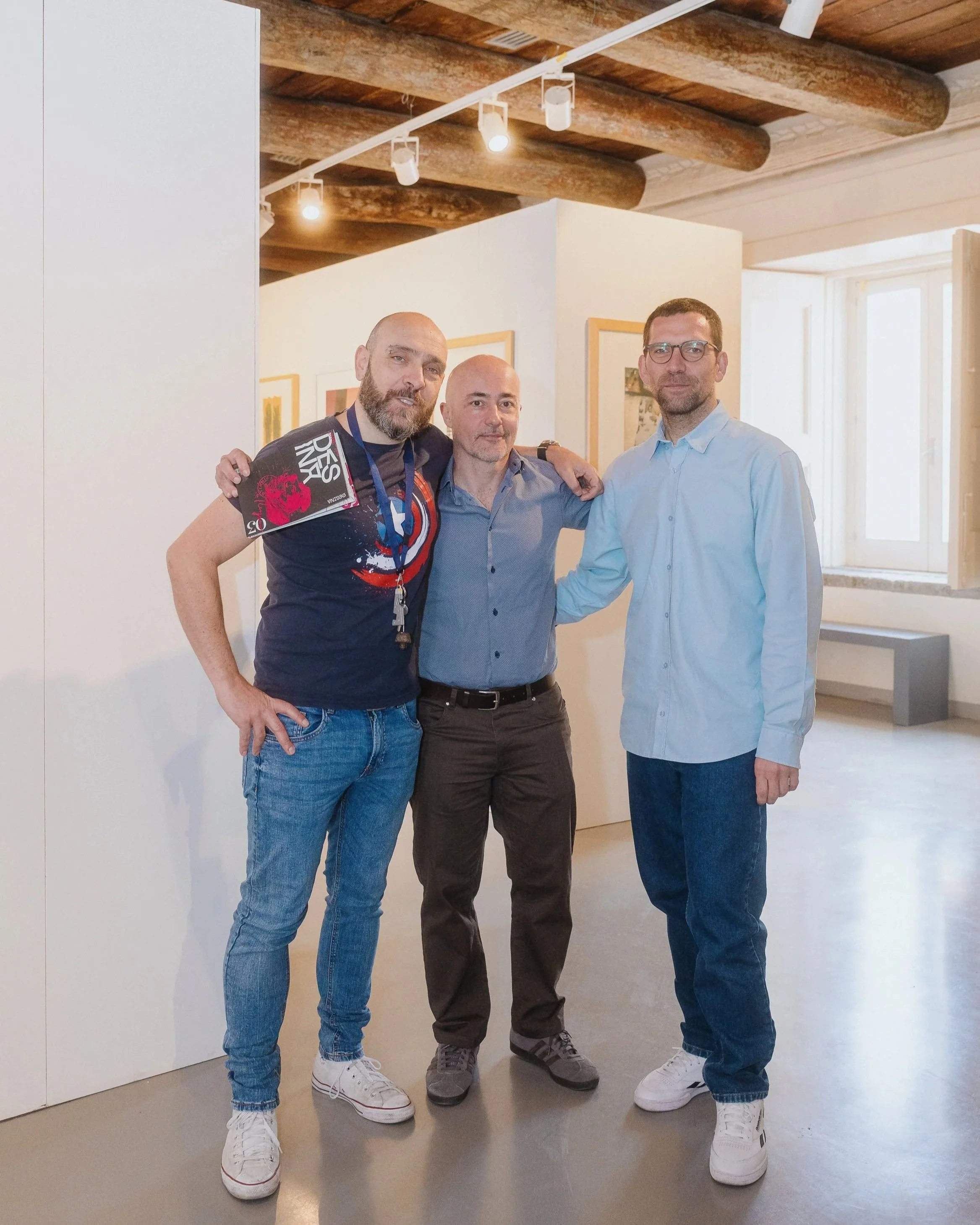
Nicola Feo, Stefano Pellone and Domenico Armatore – founders of DESINA festival.
Stranger #16
Stefano Pellone, Nicola Feo, Domenico Armatore, founders of DESINA festival.
I’ve always been fascinated by the energy and genuine creativity that live in places like Naples. It’s exactly there that a project like DESINA can be born – from a deeply human and warm approach. DESINA is, first of all, a cultural association created to inspire young minds, open up new horizons and encourage them to imagine things they might never have thought possible. It is best known for its annual festival dedicated to graphic design and visual communication. I find a project with a purpose like this incredibly precious and rare in today’s landscape, and I feel both grateful and hopeful to see initiatives like this growing and flourishing in Italy. Domenico, Stefano and Nicola are three professionals working in communication and design, each with different roles and backgrounds, yet all driven by a strong sense of community and responsibility – both as designers and as people working within the communication industry. They truly believe in the impact of small choices and in the importance of questioning messages and working coherently with one’s own values. And speaking of impact, DESINA is one of those projects that creates something tangible within its territory. It gives many young people the opportunity to connect with national and international professionals – something that often requires moving to bigger cities like Milan or Turin, or even abroad. While talking with them, I could clearly sense their passion and understand why DESINA has become a kind of home. That’s because of the conviviality and the deep sense of welcome that each of them carries within their personalities. This conversation is about the creation of a living festival – one that grows, changes and transforms – and about what it means to practice resistance, especially in uncertain times.
How would you introduce yourself?
D: Individually, I’m Domenico Armatore, a communication professional. As a group, I would describe DESINA as a bunch of crazy people who tried to do something interesting in Naples and who will keep doing it for as long as we can.
S: I’m Stefano Pellone, a visual designer. I studied architecture, then realised that graphic design interested me more. I mainly work with typography, branding and motion design, but my interests are constantly evolving: I move from one discipline to another and always maintain a certain level of dissatisfaction.
I met Nicola and Domenico a few years ago. Each of us had our own agency in the local area, and that’s how we first crossed paths. Domenico had opened up a round table discussion around visual communication, design and creativity more broadly, and in the end the three of us stayed. We realised we shared a strong alignment of intentions and also connected well on a human level. That’s how the idea of working together on a project was born and that project became DESINA.
N: I’m Nicola Feo, and I’m just the group’s copywriter (laughs). I agree with everything Stefano and Domenico have said. I’d only add one thing: DESINA was created to inspire young minds, to show them new horizons and encourage them to create something innovative, to give them a spark to imagine things they might never have thought of before.
What were the key moments that led you to where you are today?
S: For me, a crucial moment was realising that the course of study I was following (editor’s note: architecture) didn’t truly represent what I wanted to do. I understood it quite late, when I was almost graduated. I decided to finish my degree anyway, also because architecture is a demanding field, but by that point I had already developed a strong passion for graphic design.
After that, I enrolled at IED in Rome. It was also a way to make the people around me, especially my family, understand that I had a different idea of what I wanted to do. It wasn’t easy. I then gained experience in an agency and, in 2007, I founded my own studio, Bluelabs, together with my partner Mariano Pacileo, here in Naples. When things started to work, others began to understand too.
N: Like Stefano, I also followed a path through agencies. As for DESINA, everything started in front of a pizza. The three of us were sitting there talking about what to do and how to do something together, and at some point we said: why not create a festival?
Stefano was the first one, as we say in Naples, to “throw the three on the table” (editor’s note: a reference to the card game tressette). From there, a conversation began that eventually led us to launch DESINA. The pizza matters because we often say that DESINA wasn’t born as a cold or aseptic project, but as something very human, very warm.
D: My path took me from studying in Naples to Rome and then Milan, where I lived for two and a half years working in an agency. After that experience, I decided to come back and start my own agency as well. A few years later, this other project began, DESINA, which for me is one of the most beautiful projects I’ve ever developed, also because it’s shared with Stefano and Nicola. It was a real breath of fresh air. It brought new commitments, of course, but professionally it has given us a lot: it allows us to build a network, which is a fundamental part of our journey.
S: DESINA is, first and foremost, a cultural association, created also to emphasise its non-profit nature. The association’s first project was the festival, which has now reached its fourth edition.
Technically, it’s a festival about graphic design and visual cultures, with a strong focus on education: talks, workshops, exhibitions, performances. But for us it’s much more than that. It’s a place for debate, a space where after four years a community comes together, both local and national. It’s a space for local talent.
What has been the biggest challenge you’ve faced so far?
D: I’d definitely say the beginning of DESINA. We had planned everything and secured a location –kindly offered by the Municipality of Naples – but one month before the event it was just as kindly taken away from us. You can imagine the panic.
It was the first year, so maybe some mistakes were forgivable, but it was a really tough moment. Thanks to partnerships with local institutions such as the Academy of Fine Arts of Naples and FOQUS – Fondazione Quartieri Spagnoli, we managed to reorganise.
Looking back, maybe without even realising it, we ended up doing something more in line with what the festival eventually became. We had initially planned for a space hosting around 100 people – and we would have been more than happy with that – but the very first edition far exceeded our expectations. Still, that moment, less than a month before the event, was truly challenging.
N: As Domenico was saying, we were expecting about a hundred people, and more than 4.000 showed up. I’d say it went pretty well!
For me, one of the hardest moments was the first call with Erik Kessels. Stefano and I invited him as our first major guest, even though we basically had no budget to offer. We decided to try anyway. During the call, after explaining the project, we got to the topic of fees and told him very honestly that we could only offer a few hundred euros. He looked at us and said, “I’ll come anyway.” It was one of those moments that are incredibly difficult and incredibly beautiful at the same time.
S: The first edition was definitely the most demanding: everything was new. From the first call with an international guest, to handling the logistics of an event – we work in communication, not in festival organisation.
Over time, with every edition there’s always some unexpected issue, but now we approach it with a certain zen attitude. The real major challenge, however, has always been the festival’s financial sustainability.
DESINA has a tangible impact on the territory: it gives many young people the opportunity to connect with professionals, agencies and high-level national and international content, without having to move to Milan, Turin or abroad. This is why people come from all over Central and Southern Italy.
There is a lot of satisfaction, along with recognition and the festival’s growing reputation. Today, it even happens that speakers reach out to us. But the issue of sustainability remains: it’s a huge investment in terms of time, energy and personal finances. From the next edition onwards, it will need to work better, and we’re already working on that. Beyond that, I see a lot of passion, enjoyment and emotion.
Let’s talk about DESINA, the first festival dedicated to graphic design and visual cultures in Central and Southern Italy. How have you seen the project evolve over time?
D: DESINA was first and foremost conceived as a moment of encounter. It takes the form of a festival, but in essence it’s much more than that – both for us and for the people who take part, whether as guests or as members of the audience.
There’s a very strong feeling around it: we’re starting to see that people look forward to the festival with great enthusiasm, regardless of the specific content the guests bring to the stage, to the exhibitions or to the workshops. There’s a fundamental human aspect to it, the act of coming together.
The audience is made up of professionals and agencies, but also many students. This creates an active exchange between different generations and gives younger people the opportunity to come into direct contact with very high-level professionals from Europe and the United States. This is probably the aspect we love the most: having created a space for debate and exchange that lasts several days, often in a very horizontal way.
S: While Domenico was speaking, I was thinking about how today many people consider DESINA a fixed, unmissable appointment, almost regardless of the programme. It brings to mind the concept of “third places”: spaces you go to for the atmosphere, because you know you’ll feel at home, no matter who’s on stage.
DESINA has become a bit like that: a home, a community. There’s a very strong sense of belonging that, as regular attendees of other long-established festivals, I have to say we’ve never really felt elsewhere. I think this has a lot to do with the DNA of Central and Southern Italy.
The pizza episode Nicola mentioned earlier isn’t random, it represents conviviality, a way of approaching things that we also bring into the festival. It’s one of the reasons why many guests want to come back: maybe they can’t give another talk, because we try not to repeat content, but they still want to be there. The sense of welcome and the atmosphere tend to leave a stronger impression than the individual content, which we nevertheless curate with great care.
N: I’d like to underline that DESINA is a deeply horizontal festival. We always tell our guests this: we choose them above all for their attitude. There are no unreachable stars at DESINA.
This year we had David Carson, and he was stopped by so many young people. It was incredible – he spoke with everyone, gave feedback, and stayed present for the entire duration of the festival. This is something both the audience and the guests appreciate, because it allows everyone to simply be people again, to engage, to learn from one another. It’s a core value of DESINA: its democratic nature, the direct, one-to-one relationship.
One of the festival’s goals is to be a source of inspiration for those who are moving, sometimes for the first time, into the world of design and visual communication. In your view, what is the relationship between the new generations and graphic design?
S: I’ll answer as the graphic designer of the group, also drawing from my teaching experience.
I have the feeling that I learn more from them than the other way around. What we can really offer is a story, a set of skills, a vision shaped by experience, rather than technical notions, which I actually consider the least important part.
Young people, on the other hand, have their feet firmly planted in contemporaneity, and I find this incredibly valuable. Compared to my generation, they have much more freedom in mixing styles, techniques and approaches. When I was studying, we reasoned in very rigid categories, including disciplinary ones. Today, instead, I see a great ability to let historical, geographical and cultural references – apparently very distant from one another – coexist.
Sometimes there is also a bit of superficiality, because these references are not always explored in depth. But it is precisely in this crossbreeding, in this hybridisation, that something new can emerge. Repeating what already exists in an uncritical way makes no sense.
Personally, I’m very drawn to what I don’t understand. When something confronts me with a question mark, if it sparks my curiosity, it holds my attention. And that’s where a real exchange with the new generations begins – an exchange that I find extremely enriching.
The theme of the first edition of DESINA was the impact of design. In your view, what is the responsibility of design and designers today?
S: The theme of the 2026 edition, Visual Resistances, can be seen as a natural extension of the concept of impact. We are talking about projects, practices and positions that are grounded in values and driven by a social purpose.
When we speak about the responsibility of the designer, we mean the ability to question messages, to avoid working uncritically, and to maintain a critical stance that is coherent with one’s own values. Without this coherence, the possible paths become endless, but any sense of recognisability is lost.
We are living in a dramatic historical moment, surrounded by wars, crises and conflicts. We feel a responsibility to bring these themes into the festival, knowing that our content reaches thousands of young people. It is a responsibility that starts with the individual designer and, in our case, becomes a collective responsibility.
D: Communication today carries an enormous responsibility, especially in the way it educates new generations. Anyone working in graphic design, communication or advertising cannot ignore what is happening around them.
We are part of a system with many critical issues, and simply acknowledging this is already a first step. A minimum level of responsibility today is necessary.
N: From an educational perspective, as teachers, we try to pass on a respectful approach. This also applies to writing: thinking about gender, accessibility, and the possibility that on the other side there may be a disability. These are small choices, but they can have a significant impact. Graphic design and design are everywhere, and even small acts of resistance – like choosing a font, a theme, or refusing a project – can have much broader repercussions on society.
I often wonder whether there are still more “privileged” stages than others for making art or design. What do you think?
S: Yes, I do think differences still exist, both in terms of geography and cultural infrastructure. With DESINA, however, we’ve always tried to work in continuity rather than in opposition: we’re interested in presenting both more traditional approaches and more contemporary, even extreme, expressions, without creating hierarchies.
The same applies to geography. Naples is not used to hosting this kind of event in the way Milan is, for example, nor does it have the same infrastructure. That said, our experience over the years tells us that this is perfectly fine. On the one hand, certain things are missing, on the other there are unexpected and precious elements.
There is, however, an objective reality: the worlds of art and design are still highly elitist. With the festival, we try to make them as non-elitist as possible. The first three editions were free, from the next one, we’ll introduce a symbolic ticket price for sustainability reasons.
The truth is that these disciplines are born in exclusive contexts, and even today active work is needed to make these spaces more open, fair and accessible.
D: It also very much depends on the discipline you’re talking about. In Italy there are places with a stronger historical legacy that naturally become attractors, such as Milan or Turin. Many young people from the South move there to study and work.
At the same time, I think something has shifted since the pandemic. DESINA is proof of that. Perhaps if it had been born ten years ago, it wouldn’t have had the same impact. Today we see festivals emerging in regions like Puglia and Basilicata, often thanks to people who passed through DESINA and later asked us for advice.
This shows that geography matters only up to a point. It takes commitment, but things can be done anywhere.
N: It’s encouraging to see new initiatives emerging in the South that don’t position themselves in opposition to those in the North. On the contrary, we are among the founders of the Italian festival network precisely to foster collaboration. The goal is to spread a culture of good graphic design, not to create divisions.
DESINA was born in Naples to engage with the local artistic and cultural dynamics and place them within an international context, becoming a creative incubator. How would you describe this local–international relationship between Naples and the rest of the world?
D: From the very first year, we thought of DESINA as a “glocal” project: deeply rooted in Naples, yet with an international outlook. This is reflected in the programme, which includes both Italian and international guests, without ever losing sight of local talent.
The festival has become a showcase for professionals from the area who work at a very high level, but also an opportunity to build a network – something that historically has always been somewhat lacking in Naples.
Today, DESINA is a space for exchange between professionals, students, universities and institutions. A place where the local truly enters into dialogue with the international.
DESINA focuses on graphic design and visual cultures: what role does visual identity play, for you, in building a sense of community or belonging?
S: I’m obviously biased, but I believe visual identity plays a fundamental role in building recognisability. It is the visible expression of a deeper coherence, of a shared set of values.
In DESINA’s case, the visual system has clear pillars, but each year it is reinterpreted according to the theme. For me, this is an extraordinary experiment, because in professional practice you rarely have the chance to let an identity evolve in this way – maintaining coherence while changing language.
It’s an evolving, multi-channel project that lives across very different media: social platforms, the website, signage and merchandising. Seeing the system work across all these levels is extremely stimulating.
Having the 2024 identity selected for the ADI Index was a great achievement, and of course we intend to continue along this path.
D: For me, graphic identity is the festival’s outer layer, but there’s also an immaterial identity made up of experiences, relationships and memories. That’s what people take home with them.
Often, brand identity is reduced to logos, fonts and colours, but the strongest brands are those that leave an emotional trace. In our case, this identity formed spontaneously and is still evolving.
N: DESINA is a living festival. It grows, changes and transforms. I still remember the first opening night: I arrived late and saw one of the volunteers wearing a T-shirt with our logo. It was incredibly moving seeing an idea become something real and shared.
How are the festival’s themes chosen?
S: They come from observing reality, from the need to send a signal.
In the first year we talked aboutimpact, then Blur, borrowing an expression from Pino Grimaldi – a renowned local figure who made a major contribution to the evolution of graphic design theory – intended as an area of intersection between disciplines. Follia (Madness) was perhaps the most playful theme, the one that allowed us to experiment the most.
Resistenze Visive (Visual Resistance) stems instead from an urgent necessity: we’re living in a complex historical moment and we feel a duty to take a stance. Themes arrive first as human needs, and only later as curatorial choices.
What does the future of DESINA look like?
N: First of all, an edition after the next one! We move forward one edition at a time. (laughs)
D: DESINA was born as a cultural association, with the festival as its main project, but the idea is to evolve it into a broader creative platform.
We’re working on initiatives that go beyond the festival itself and unfold throughout the year. The next edition will be crucial in understanding which direction to take.
N: Over time the project has grown: today we’re almost twenty active people, in addition to volunteers. This allows us to add small pieces step by step. DESINA grows together with the people who share its vision.
S: Dreaming big, I’d love to turn DESINA into a continuous presence – a place that exists all year round, with exhibitions, talks, residencies and debates.
More than the physical space, what matters is the idea of always being there. That would be the greatest dream.
Could you name someone who inspires you or someone you deeply admire?
D, S, N:
We all agree on Francesco Dondina.
Founder of the Milano Graphic Festival, founder of Dondina Associati, and author of books that are fundamental to the discipline.
But above all, he is a person of great human generosity: from our very first contact, he has been a point of reference and an invaluable source of support for us.
