

Gary Bigeni
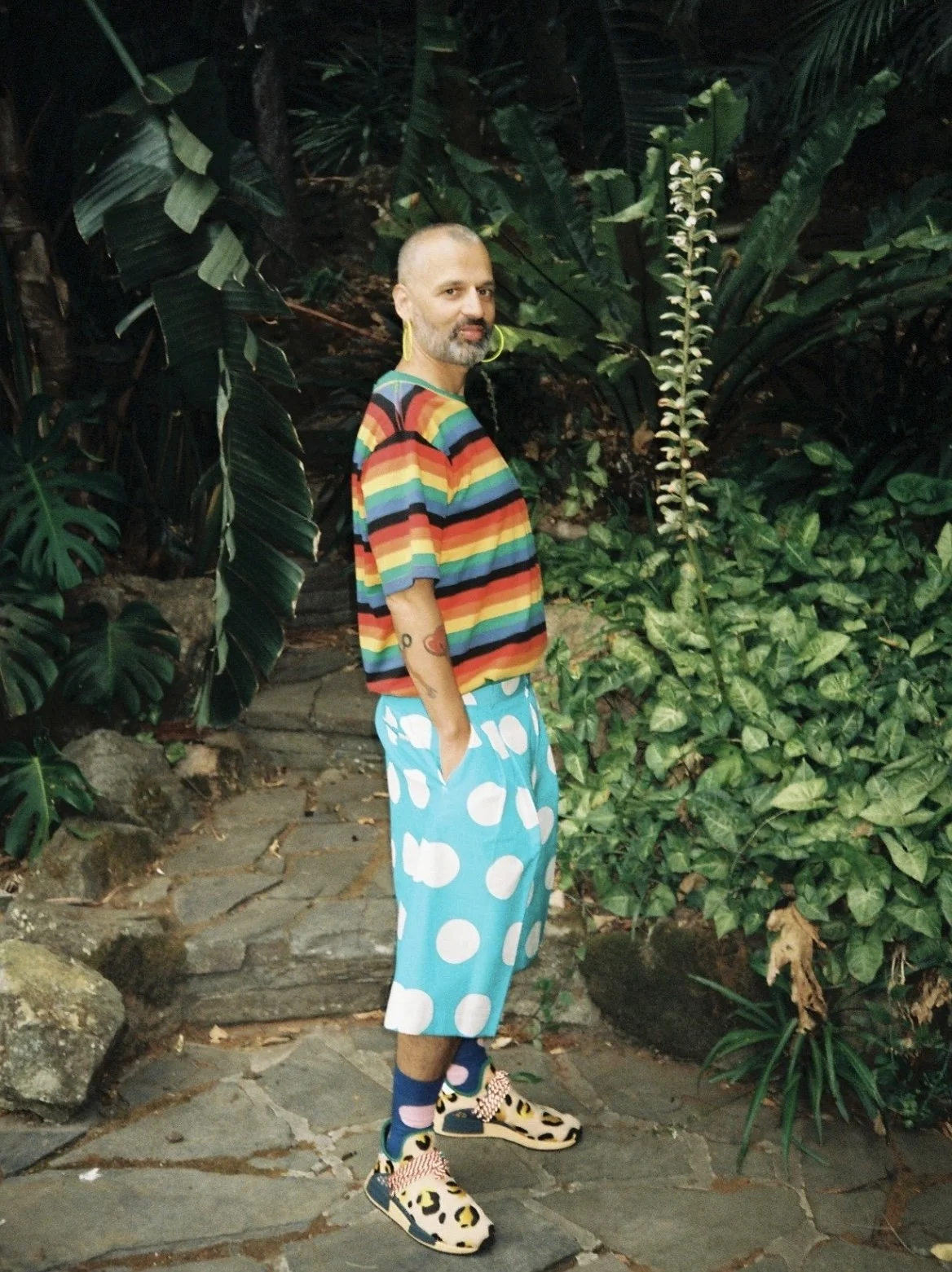
Ph. Brooklyn Brandy
Stranger #17
Gary Bigeni, Fashion designer & Founder of the label Gary Bigeni
In one of our last emails, Gary told me: "Don't do black and white, it's all about colour." This quote stayed with me not just as creative direction, but as a reflection of who he is. So positive, so full of life. For Gary, fashion is never just about clothing. It's about building a world where people feel seen and accepted, regardless of size or gender. Gary Bigeni creates a world full of joy and warmth, where colour is a shared language. He keeps asking himself how his work can evolve, how it can respond to the present, and how he can use his platform to show up for his community. This conversation gets into what it really means to create with inclusion at the centre, to advocate for others and to navigate the industry as an independent designer working with a made-to-order model. It's an honest reflection on responsibility and on what it looks like to stay true to your values.
How would you introduce yourself?
My name is Gary Bigeni, my pronouns are he/him and I live with a hearing disability. I’m also a queer man, and that’s something I always name upfront. That’s me, before anything else.
I’m a fashion designer, educator and facilitator. I teach fashion design at university and I also run sewing programs for primary school children aged 10 to 12. Alongside that, I facilitate queer workshops for neurodiverse and autistic young people.
I also run a queer mental health program where I introduce sewing as a form of art therapy, a way for people to come together, build community and feel connected. I’m especially interested in creating safe spaces for those who might struggle to step outside their comfort zone – spaces where they can feel supported enough to engage.
I’ve been working on my brand for over 22 years now. Just before COVID, I went back to study social work for two years. Coming out of that experience, I started asking myself how can I give back to the community? I wanted to bring together my background in fashion and my desire to support others, to create positive, welcoming environments through sewing and creativity.
Could you share a few key moments that have shaped your professional journey?
I think one of the biggest milestones is simply still being here, working as an independent designer for over 22 years. That longevity means a lot to me. I’ve stayed true to myself and to my vision as I’ve grown, and my work continues to speak about the things that matter deeply to me, such as diversity and inclusion.
As a designer living with a disability, I feel a strong responsibility to speak about inclusion across age, gender, culture and body. That commitment is something I consider a real achievement.
Participating in the Australian Fashion Week over the past few years has also been a significant milestone. It’s been incredibly meaningful to present my work on that platform while staying authentic to my values.
Another defining shift was moving towards a fully made-to-order model. For the past five or six years, I’ve stopped mass producing. Every piece is made to order. I hand-paint garments myself in the studio, I wash them and I prepare them. Of course I can produce larger orders when needed, but the intention is always the same: how can I reduce waste in an industry that is one of the largest contributors to environmental damage?
Even the way I package my pieces reflects that thinking, using recycled materials, no plastic, no hangers. For me, those details matter. They are small but important milestones in building a sustainable business. I believe we all need to rethink how we participate in fashion and in sustainability.
And beyond sustainability, I care deeply about how people see themselves. Image plays such a powerful role in identity and confidence. I want women and men, of all sizes, to feel that they can relate to my brand, to feel seen and to love who they are.
Colour is a big part of that. I live in colour. I want to spread joy and warmth through what I create. When someone buys a piece I’ve worked on and I see their reaction, it feels personal, and that’s something I’m very proud of.
What has been the greatest challenge you’ve faced in your career, and how did it shape you?
Growing up as a queer man with a disability has always been a challenge. Finding my place, first as a young person, then as an adult, meant constantly navigating communication, acceptance and belonging, even among your peers.
Running a small business on your own is another ongoing challenge. When you’re the only person behind the brand, everything sits with you, especially finances. Capital plays a huge role in fashion and if you don’t have the money to scale in traditional ways, it can feel limiting. I’ve carried those pressures for many years.
Over time, though, I realised I didn’t have to follow the traditional model. I didn’t have to work seasonally or operate the way bigger brands do. I could create my own lane.
A big part of that journey has been understanding what works for me and for my business and learning how to speak directly to my customers in an authentic way. Instead of trying to fit into the norm, I’ve focused on building something that feels aligned with my values. And that shift has been one of the most important ways I’ve grown, both personally and professionally.
When did you realise that you wanted to be a fashion designer and how did you start your label?
I was completely obsessed with Barbie as a child. I would steal Barbies from my cousins, from the girls next door, from anyone up the street, I just loved them. I had this secret identity, where once everyone went to sleep, I’d wash their hair and make tiny outfits for them. I did that for years.
That’s really where it began this obsession with creating, dressing and imagining. As I got older, the passion only grew. When I was 11, my mum bought me my first sewing machine. I started making clothes for my sisters and friends and in high school I chose Design and Technology. That’s when it became more serious.
In 2000, at age 18, I was accepted into the Sydney Institute of Technology. That was a huge moment for me. I promised myself I would work incredibly hard. Being hearing impaired made studying challenging – it was very distracting and overwhelming at times, but I was so committed to it and I pushed myself to keep up.
When I graduated, I was selected as one of four students to present a collection at the Australian Fashion Week as part of a graduate collaboration. We had to produce a 15 look collection. I had no money. I bought a draped jersey – it was the cheapest fabric I could find – and started draping directly onto mannequins. I photographed everything, scanned my ideas and brought them back to my lecturers for feedback and they encouraged me to keep going, that what I was creating was beautiful.
I completed the collection and from there things began to move quickly. A few stores, local and international, picked up the work. I received some very good press and that gave me momentum. I started building small collections, showing buyers and growing slowly.
A pivotal moment was being mentored by Belinda Seper, a highly respected fashion buyer in Australia and internationally. She saw something in my work and took me under her wing. I would show her my designs, she would give me honest feedback and she even offered me a workspace above one of her stores.
From there, the brand continued to evolve presenting at Fashion Week, selling both locally and internationally, refining my language through colour and print, collaborating with artists and building lasting, meaningful relationships.
Your label is described as pushing the boundaries of fashion as individual expression through custom, made-to-order fine-art collections. Can you tell me more about this vision?
Over the last 22 years, my business and my aesthetic have evolved a lot. When I first started I was known for draping and twisting fabric. That was really how I established myself in the industry. It was very sculptural, very hands-on.
But the industry has changed dramatically. When I began, there was no social media. It was all about meeting buyers in person, printing lookbooks and line sheets, building relationships face to face. Now it’s an incredibly competitive and fast-moving landscape.
Over time, my work has become cleaner and more refined in its shapes, but colour has remained central. I think a lot of people are afraid of colour, they lean towards black, white and grey. For me, colour is a way of expressing individuality and emotion. It doesn’t have to be overwhelming – sometimes it’s just about injecting a considered touch of colour into an outfit, something that feels personal.
The made-to-order model is also part of that vision. It allows each piece to feel intentional and considered, rather than mass-produced. It creates a closer relationship between the garment and the person wearing it.
Staying true to my vision and really listening to my customers, is what guides me. And at the same time, I allow myself space to evolve. I’m actually thinking about returning to draping next year, revisiting where I started. I haven’t done it for a while and it feels exciting to reconnect with that part of my practice.
Of course, creativity takes time, money and energy. But giving myself permission to explore again is important. That’s how the work continues to grow.
Where do you usually draw inspiration from?
It’s usually the world around me, such as movement, energy and people. I find it difficult to create from a theme that doesn’t carry emotion. For me, inspiration has to come from a feeling.
Because I’m hearing impaired, my eyes often become my ears. I pay close attention to detail, how people move, what they wear, how fabrics sit on the body when I’m out in the world. A small detail can spark an idea that grows into something bigger.
I also spend a lot of time experimenting directly on the mannequin. Draping, adjusting, playing with shape. A physical process that often leads me somewhere unexpected.
Colour is always central, as well as collaboration. Working with print designers and artists inspires me deeply. I’ll sit with them and talk about what I’m feeling – sometimes it’s about movement, sometimes about freedom.
For example, my last collection Dance Bigeni, came from my love of dancing. I love the feeling of being a free spirit through movement, rhythm, colour and fluid shapes. That sense of freedom is often where my inspiration begins.
You design gender neutral pieces in an industry that is still very gender segmented. How do you feel about this, and what drives your approach?
Growing up, I was always drawn to florals, colour and print. Things that were often marketed to girls rather than boys, but that never made sense to me. As I got older, when I was op-shopping or buying clothes, I chose pieces I loved regardless of whether they were on the men’s or women’s rack. That division never felt relevant to me.
That’s really where my approach to gender neutral design comes from. My collections are for everyone. I don’t want boundaries around gender or sex. I want my clothes to be worn by anyone – male, female, trans, non-binary. That’s my community. I design different sizes and shapes so garments can adapt to different bodies.
Presentation is also important. When I show at Fashion Week, I include different genders and different sizes on the runway. It matters that people see themselves reflected in the work, on Instagram, in lookbooks, on websites. I don’t want inclusion to be a box-ticking exercise, it should be ongoing, visible and embedded in the practice.
A few years ago, I went through a health period where I had to take steroids and inject medication. I gained 16 to 18 kilos and it was something completely out of my control. It was part of healing, but it changed how I experienced my body. Even after losing some of the weight, I had to adjust to clothing differently. It took time to accept my body and love it as it was.
That experience deepened my understanding of what it means to feel seen. If someone can look at a runway or a campaign and see a body they relate to, someone confident and comfortable, that can be powerful. That’s what drives me.
You once said you’re passionate about fashion for teenagers and kids, helping them grow into who they truly are rather than fitting into something they’re not. I find this fascinating. What would you love to create in this space?
For me, it’s about creating safe and welcoming spaces. I run workshops once a month and I also teach students in years 4, 5 and 6 during the school week.
It’s not just about fashion, it’s about sustainability, upcycling and mental health. Many young people aren’t exposed to those ideas in creative ways. Through activities like tie-dyeing or transforming denim into bags, they get to create something colourful and walk away feeling proud.
But it’s also about comfort. If a young person comes in and doesn’t want to participate – if they just want to sit, have a can of Coke and a packet of Twisties – that’s okay too. The space exists for them. Especially for neurodiverse kids and young people on the spectrum, having a place that feels non-judgemental and open is incredibly important. They communicate differently, but they are just like everyone else.
Recently, I was announced as the 2026 ambassador for Twenty10, a non-profit organisation that supports LGBTQI+ youth through counselling and safe spaces and I feel very honoured about that.
I’ll always be a fashion designer. But I’m also always asking myself: how do I evolve? What do I want to stand for? And how can I create something positive for the next generation?
What’s the relationship with the new generation with fashion?
It’s very different from when I studied. I teach fashion design at UTS, and I notice that students now operate in a very digital, fast environment.
There’s a lot of surface-level inspiration coming from phones and social media. It’s quick, visual, immediate. Sometimes there’s less deep research, less time spent in archives, studying the history of a brand and understanding context. Ideas can feel more screen-based and less tactile.
But at the same time, it’s fascinating. We’re seeing fashion cycles repeat – what I wore in the late ’90s and early 2000s is coming back, just interpreted differently, with more layering and texture.
I feel that the challenge now is encouraging depth in a very fast world.
After working within a more wholesale-oriented business model, you now create custom pieces as an independent label. When and why did you decide to make this shift?
It happened quite organically, just before COVID. Someone wore one of my sample pieces on a TV show – it was a garment I had made for a runway presentation. When the episode aired during COVID, I started receiving messages on Instagram and emails asking “Where can I buy that dress?” People were even contacting the network.
In that moment, I remembered something I was taught at school: when an opportunity arises, respond to it. So I called a friend and asked if I could photograph the dress on her. I uploaded it to Instagram and put it on my website as a made-to-order, hand-painted pre-order piece.
The response was incredible. Customers paid upfront and I hand-painted and produced each order. I realised how much more engaging this model was. I was speaking directly to customers through social media and email. I understood who they were and what they loved.
It felt sustainable, manageable and exciting as a small business. Instead of investing heavily in wholesale production, I was producing only what was needed.
That moment reshaped my business. From there, I expanded into more styles and colourways, always within a made-to-order model, always thinking about reducing waste.
The uniqueness of the wearer is central to your work. What is your relationship like with your customers?
Over the past five years, I’ve built a strong and direct relationship with my customers. Social media has allowed me to share more of myself, my studio process, my painting and the everyday reality of running a small and sustainable business.
People connect to that authenticity and they want to support a local, independent designer. Especially after COVID, many people became more conscious about where their money goes. There’s also a real sense of community. My customers reach out, ask questions and share photos. It feels personal and that’s important to me.
What does sustainability mean to you, both in fashion and more broadly?
Sustainability is about reflecting on your practice and how your work impacts people, the environment and future generations. Fashion can create enormous waste. I feel anxious when I see racks and racks of clothing at big sales. When I started, we produced two collections a year. We had six months to develop them, refine them and present them to buyers. Now everything feels like a constant search for what’s next. We need to slow down.
For me, sustainability also means buying thoughtfully. I want pieces I can wear for a decade or more. If something wears out, how do I repair it instead of replacing it? Upcycling workshops –including my own– are part of that mindset. It’s also about educating yourself and your customers. Made-to-order garments take time. They aren’t delivered in five hours. But that time has value – it reflects care, craft and intention.
Even as a small or exclusive brand, you’re still competing with fast fashion. Designs can be copied instantly. So the question becomes: what are you bringing to the table that is different? How are you contributing in a more responsible way?
For me, sustainability is about slowing down and truly being intentional.
Is there a dream project you haven’t realised yet, something you would love to bring to life?
I would love to design costumes for a contemporary dance production in Europe or somewhere that celebrates movement and colour.
Dance, colour and fabric all connect for me. Creating sculptural, expressive pieces for dancers, something dynamic and alive, would be incredible. It would be a lot of work, but it would be awesome.
Is there someone who inspires you or whom you admire?
I would like to nominate my good friend Michael Hankin, who works across prop design and costume for theatre.
