

Stranger #24
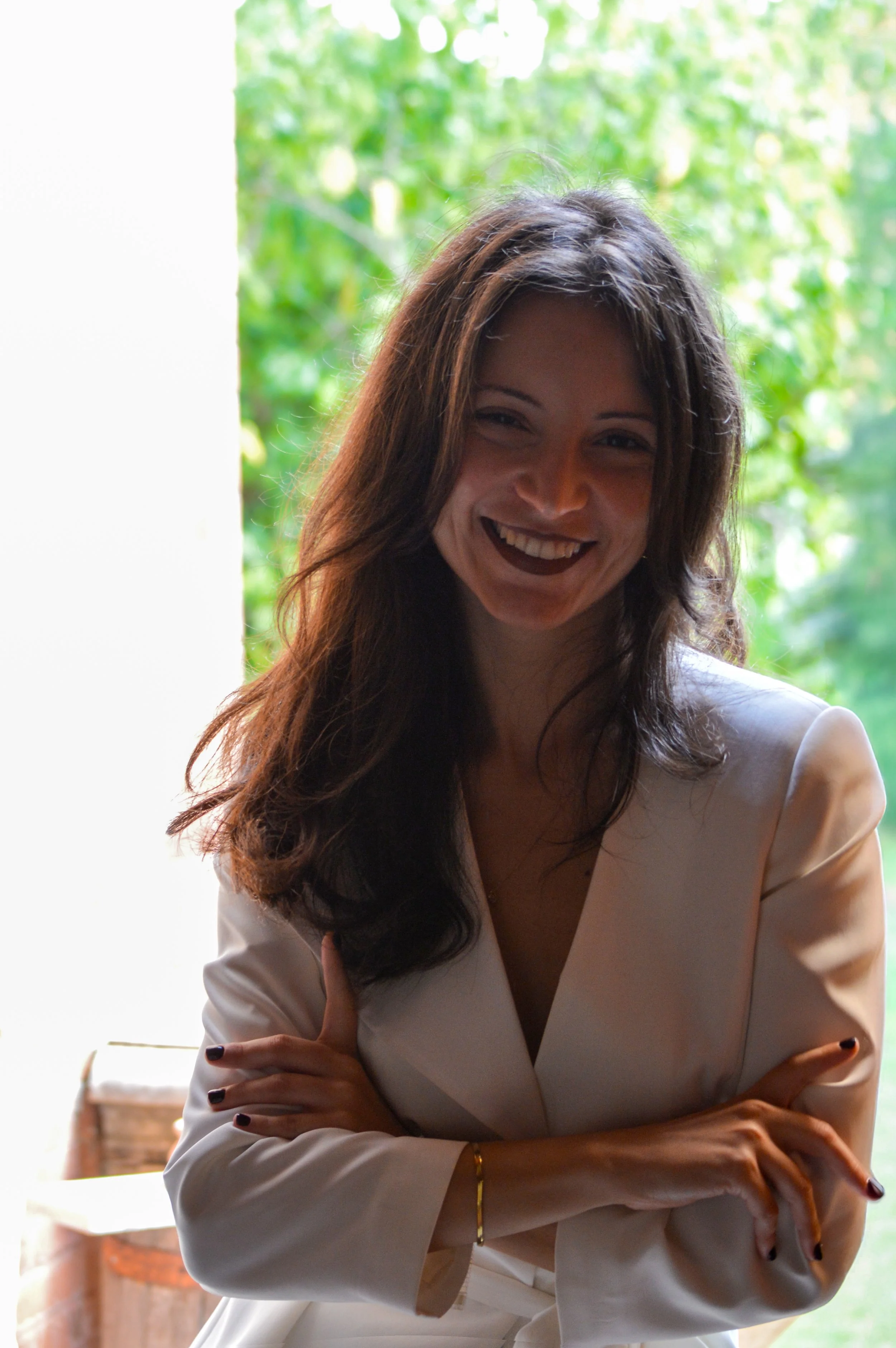
Katia Pecoraro, Sicilian-born independent graphic designer and art director.
Meeting Katia was such a nice and unexpected coincidence. Nominated by Armando Milani, as soon as I heard her name, it rang a bell. Then I realised I'd already met her while I was at IdLab, teaching at Raffles University, where she was a student. I was really impressed by the career she has built so far, having worked at two of the world's most important design studios, Pentagram and then Snøhetta Design, two great firms that I've always admired. During my conversation with Katia Pecoraro, I found a very determined woman, with a strong sense of direction and a passion for what graphic design represents and its social importance. Her work with the EAT Foundation was exactly the kind of graphic design she believes in: something that encourages people to open conversations about topics we're struggling with, or simply to start conversations we would never have thought about, all because of a pictogram. We talked about roots, something very important to Katia (and to me too). Roots as our origins, our personal culture, family and hometown, but also roots given to us by the people who came before us and left a heritage, perhaps a graphic design heritage, from which archives are built and which need to be reactivated and brought back into our contemporary world. I left this conversation feeling very connected to what we'd talked about: coherence, sensitivity and exploring new worlds to find the freedom to reinvent yourself again and again.
How would you introduce yourself?
I would describe myself as someone with many layers, shaped by my island origins and by the different places I’ve encountered along the way. I’m Sicilian, and later I moved towards the Nordic countries, passing through Central Europe. But beyond the physical idea of place, I also feel that I have many layers within myself. My background began with humanities studies and I later embraced the world of design which, alongside its humanistic dimension, also has a very technical side.
I see myself as someone with many layers, but also many contrasts. I’m very perfectionist and almost sombre in my work as a designer. I tend to see things in black and white and I’m very minimalist. On the other hand, there’s also a very spontaneous person who talks to everyone and likes to break those rules a little.
In your professional profile, you describe yourself as a graphic designer currently working independently, after previously working with the non-profit organisation EAT, as well as Snøhetta Design and Pentagram. What were the key moments that brought you to where you are today?
One of the key moments was definitely at the end of my master’s in graphic design in Milan, when I found the courage to look beyond the Italian design scene. I had a lot of energy at that point in my life, and I decided to channel it into one goal. That was definitely my first turning point, and it all happened very quickly. Within three months of sending my portfolio, I found myself working at Pentagram in Berlin.
That was my first big step. Then, after what was probably the most formative period of my life, I started to imagine myself somewhere completely different. I’ve never had one specific place where I could picture myself, or one particular path I felt I had to follow. I simply felt the need to experience something very different. I knew almost nothing about Oslo and Snøhetta at the time, I just wanted to throw myself into something new. That was the second key moment.
The third is actually happening now. A lot has happened this year, and after the closing of the EAT Foundation, I ended up back in Italy for a while. It wasn’t part of my plans, or anything I had envisioned for myself. But what surprised me was that, despite all the changes, I found myself with the same energy and enthusiasm I had when I first sent my portfolio to Pentagram.
Today, after nearly five years of working across different design studios, I’ve started a new chapter as an Independent Graphic Designer and Art Director. I’m continuing to collaborate with some of my former colleagues from the NGO, while also working with new clients from Germany, Sweden, USA and Italy.
What has been the biggest challenge you’ve faced in your career so far, and how has it changed or influenced you?
The saddest and happiest moment of my career happened at the same time: moving from a place where I no longer felt aligned with the way of thinking to one where I felt much more connected. In my case, that meant moving from Snøhetta Design to the EAT Foundation.
The biggest challenge has been learning to accept that not everyone thinks in the same way. I’ve learned how important it is to stay true to my own way of seeing things. That’s where I feel happy and confident about what I’m doing.
It was also important for me to realise how much technology has blurred the boundaries of design. I think it’s almost impossible today to feel that you belong to everything. What matters instead is finding your own focus and understanding where you can contribute. Of course, you still have to make compromises throughout your career, but having that sense of direction is important.
Your interest in design focuses on modular typography, pictograms, signage and editorial design, disciplines that require rigour, time and precision. What fascinates you about them?
What all these disciplines have in common is the search for coherence. I really like the word “coherence”, because it relates to all those things I find difficult to move away from. In many areas of design the tendency is almost the opposite, to break things down and constantly search for what comes next.
For me, coherence is much more fascinating because it allows unexpected things to happen within a system. In modular typography, for example, there’s something brilliant about seeing one letter follow the same logic as another without having to disrupt the whole family. Or, in a set of pictograms, when an element used in one icon reappears in another but takes on a completely different function to create something new. The same happens in editorial design. You visualize a grid that becomes the foundation of the pages and when you see that it works throughout the entire publication, with a few twists here and there, of course, it’s really exciting.
Those are the moments when, for me, design really happens. It’s not necessarily about the form taking over through lots of motion or 3D. Instead, the design can simply sit there and be quiet. When the system works, you know you’ve done a good job.
Your work often engages with social issues, particularly mental health and eating disorders, using design as a tool for reflection and change. When did you become aware that design could be a tool for social reflection and change? And how do you see the role of social graphic design today?
This makes me think of a dear friend of mine, who is actually the reason I’m part of this conversation today: Armando Milani. He’s someone who constantly pushes me to move beyond the very rigorous side of my personality, and to give myself the freedom to express something important, but above all, to take a position through design. He’s always encouraging me to make a poster, even just one a month, about something I feel personally connected to.
Just a month ago, for example, I designed a poster about the landslide between Nepal and Tibet, which caused destruction and loss of life. I used the five letters of “NEPAL” and “TIBET” as the main elements, making them sink into each other to reflect the landslide. The concept was already there, so there was no need to add anything else. Sometimes, it’s all about typography itself, a bit like in Emil Ruder’s posters.
When someone sees a poster that speaks to something they’re also going through, or simply reflects a sensitivity they share, it can genuinely help them. At the same time, it becomes a mark that we, as designers, leave on society.
Sadly, I think social graphic design has a weaker presence today than it did in the past. I think about the posters of Massimo Dolcini, Leonardo Sonnoli and many other designers who played an important role in this field in Italy, including Armando Milani. Today, institutions are also caught up in conversations around topics such as AI, and I feel that Italian graphic design in particular is in a more difficult position compared with other parts of Europe, where there is a lot happening.
But that’s exactly why I believe Italian graphic design can still play an active role. Italians have a particular sensitivity that has always been a driving force behind our art and literature. Perhaps that feels weaker today than it did in the past, but it can become active again if, among all the conversations we’re having, we also make space for conversations about social design.
We must also remember that beyond the wars and climate tragedies happening around us, there are also battles taking place within each of us. As someone who has experienced eating disorders and mental health issues, I know that we bring those battles with us into the studios where we work, where we meet new people and different cultures, each with their own beliefs. I think it’s important not to suppress these things, but to make them visible without being afraid of being judged.
My experience at EAT Foundation has reinforced that idea as well. I’ve worked on medical publications and reports about food and nutrition, and this has given me the opportunity to have conversations with colleagues, CEOs and people completely outside the design world. It made me realise how significant a role graphic design can play. Even something as simple as designing an icon of a carrot can lead to a much deeper conversation. I’ll always carry these moments with me.
“Radici” is your thesis project, exhibited at Triennale Milano and MEET, which starts from the idea that everything comes from something and continues to evolve from it. Through the project, you reconstructed an archive of modern design. In a world where design is increasingly fluid and constantly evolving, what does archiving mean to you?
There are many bachelor’s and master’s programmes in Italy, particularly around Venice, that are exploring new ways of thinking about archives and archival practices. The same is happening abroad, particularly in the Netherlands, which has a strong and established design culture.
Working on Radici made me realise how important it is to rethink what an archive can be. I wanted to imagine it as something more fluid, where its different elements remain connected to one another. In my thesis, for example, I used the rhizome as a metaphor for the connections between physical and non-physical objects. A rhizome can develop through an endless number of interconnected points. Rather than arranging everything within a rigid, linear structure, it opens up an infinite number of possible paths.
This is actually an area where I think AI can be used intelligently to rethink the archive. It can make it much more accessible. At that time, I imagined mine almost as an “Instagram of design”: a place where this shared ground is within everyone’s reach and where you can explore all these different projects in one place.
I don’t think the main challenge of an archive is simply to document everything, the challenge is to keep it active. And, perhaps even more importantly, to help designers feel less alone at a time when we’re surrounded by an overwhelming amount of everything.
Our roots aren’t simply an outdated version of graphic design, or something gathering dust in a drawer. They remind us that we’re often travelling along paths that others have travelled before us, just with different tools. We’re never going to be geniuses who invent something entirely new. What makes the difference is how we take those ideas and place them into new contexts.
And what do you think about physical archives?
I find physical archives fascinating in a completely different way. I’ve travelled quite a lot across Asia and Europe, as well as the United States and Canada, and, as someone with a deep interest in signage and wayfinding, I always try to find an archive to visit. It doesn’t necessarily have to be about typography or graphic design. I’m fascinated by the archive itself: walking into a room filled with shelves, seeing all the labels and names in beautiful typography, and knowing that all of this material is stored there. It’s just something else.
One graphic design archive that really stayed with me is the one at the Museum für Gestaltung in Zürich. You can find Adrian Frutiger’s catalogues and the work of Swiss graphic designers there. You open these drawers and everything is still there, carefully preserved.
Not everything is on display. You might see some posters in the exhibition, but to discover the rest you have to go downstairs and open those drawers. I think there’s something beautiful about that. I remember seeing Geigy packaging there that, until then, I had only ever seen in books.
You’ve lived and worked abroad, between Berlin and Oslo. As a designer and as a woman, how do you experience your relationship with your roots while living in international contexts?
This is a question that’s very close to my heart because, as you’ve probably understood from our conversations, I find it difficult to separate my work and my approach to graphic design from the experience of living in a particular city.
Berlin has definitely given me a lot. It’s probably the place in the world where I feel most at home, which is strange to say because it’s a quite dark, and historical complex city. But there’s something fascinating about that complexity. It gives you the freedom to reinvent yourself again and again.
For me, that was fundamental on a design level too. While living in Milan, I often felt that I was seeing the same references everywhere. Maybe because we have such influential figures, like Massimo Vignelli, that we often find ourselves returning to. Moving somewhere like Berlin makes you realise that there’s an enormous world out there waiting for you.
But Berlin also changed me as a woman. I used to care a lot about my physical appearance and, having experienced eating disorders, I was very focused on my body. I would always eat the same things and rarely explore other cultures. From my very first day in Berlin, I realised that this was going to change. I was sharing a house with an Indian guy who cooked something for me that was completely unfamiliar. It was such a simple experience, but that day I understood that something was shifting in me and it did.
Today I’m much freer and more spontaneous. I love trying new things, and I’m no longer as focused on my body as I once was. The same change happened in my approach to art and design. Berlin makes you realise that there isn’t always a clear right or wrong. You can find yourself at an entirely conceptual exhibition and then at a very institutional one, where people are still discussing traditional German approaches to book design. You can spend the day in a museum and then go to Berghain or another club that night. You don’t have to be the same person all the time, and you don’t have to put yourself in a box and say, “This is who I am.” It’s almost the opposite of trying to archive design or trying to archive my own personality.
Oslo is very different. From a graphic design perspective, everything is impeccable. The quality of design I’ve seen in Oslo and across the Nordic countries is unlike anything I’ve seen elsewhere. But having recently learned the importance of imperfection, I realised that I actually missed it. And perhaps “imperfection” is the key word in this conversation, because I think that’s often where something brilliant begins.
And what have you carried with you from your roots?
I think it’s my spontaneity, and I don’t think that will ever leave me.
Whenever I go back to Sicily, I often find myself talking to people I don’t know. Just yesterday, someone complimented me on my glasses and I told them they were inspired by Franco Battiato, my favourite artist, who wore a similar pair during the ‘80.
Battiato teaches us that you can be a visionary even while living in Sicily, in a house in Milo. I feel very much the same way. I’m someone who likes to step outside the usual boundaries, but at the same time I don’t forget where I come from.
I think spontaneity is the thread that runs through who I am, and it has helped me a lot professionally too. When you find yourself looking for a job, for example, spontaneity helps because it gives you the confidence to talk to people, meet them and ask questions.
A job–search platform is ultimately flat, and our personalities can become flattened behind a portfolio too. A portfolio will never have the same power as a conversation. And I think Armando, who I’m bringing into the conversation once again, knows something about that. (editor’s note: Incontri, Armando Milani).
How do you see the design landscape today? What excites you and what worries you?
There’s a lot I could say about this. The fascinating thing is that my perspective can change from one day to the next, just like a software does.
Four days ago, I would have told you that I would never use AI, that it wasn’t something I wanted to explore. Today I would say the opposite, because I've just had an idea that could actually be developed using this technology. So I think the only honest way to answer is with the same fluidity: there will be days when we feel discouraged and days when we feel victorious, sometimes from one day to the next.
I woke up feeling very positive today, but just yesterday I was going through a moment of doubt. Having recently started working as a freelance designer, the landscape I see is very fragmented and uncertain. I think this is going to become an increasingly common path, rather than everything being centred around big design studios. It requires the ability and willingness to put yourself out there and show more and more of what you do.
At the same time, trying to do more and more isn’t necessarily the answer. Looking beyond is beautiful and motivating, but sometimes there is also a hidden value of the place we’re already in.
If you feel good within the structure of the studio you’re currently working, for example, that’s something worth appreciating. I was lucky enough, particularly at Pentagram, to find a place that felt like home. I miss it every day.
I don’t think it’s possible to make any absolute prediction about the future of design. But on a human level, we need to remember the importance of the small things and not be afraid of what is to come.
Is there a dream project you’ve always wanted to realise but haven’t had the chance to work on yet?
I would definitely say writing and exploring the relationship between writing and design. I’d like to find a channel and a way of making writing active, same as it is for a contemporary archive. Writing has always been part of who I am, partly because of my classical and humanities background, and even if sometimes I put it aside, it always comes back.
These days, I often feel that there’s a lack of writing that talks about form itself, rather than the medium through which design is experienced. I think of the beautiful writings of Tomás Maldonado, and the way he explored the relationship between design, society and culture.
I've recently read many interesting books on AI, memes and the way digital platforms flatten design. These help you a lot to get a sense of the basis that the form is built on, but I’d like to know more about this form itself. For example, I think of Charlotte Rhode’s typographic approach and the way she uses fluid typography. For me, this approach really reflects the time we’re living in. If you think about everything we’ve talked about before, from the complexity of Berlin to the complexity of the software and the world we live in, it all connects back to this idea.
The difficult part is that I need to make a real effort to step out of the way as a person and let the design speak for itself.
Could you name a person who inspires you or someone you deeply admire?
If I had to nominate one designer, it would be Mark Strathern.
Although he lives in New Westminster, Canada, his work has always felt close to me. I admire the way he transforms everyday observations into graphic systems, from his recent Helvetica Pixel alphabet—built from the visual language of video games—to his Instagram archive @studioboggeri , where he thoughtfully curates the work and legacy of Studio Boggeri.
We've never met, but while I was in Toronto, he took the time to mail me a small package of printed materials from the other side of the country, including a hand-cut Canadian leaf. I mailed him a Norwegian chocolate bar in return.
I think Mark has a unique way of thinking about design, and I'd love to hear his story.
