

Warren Taylor
Ph. Tobias TItz
Stranger #23
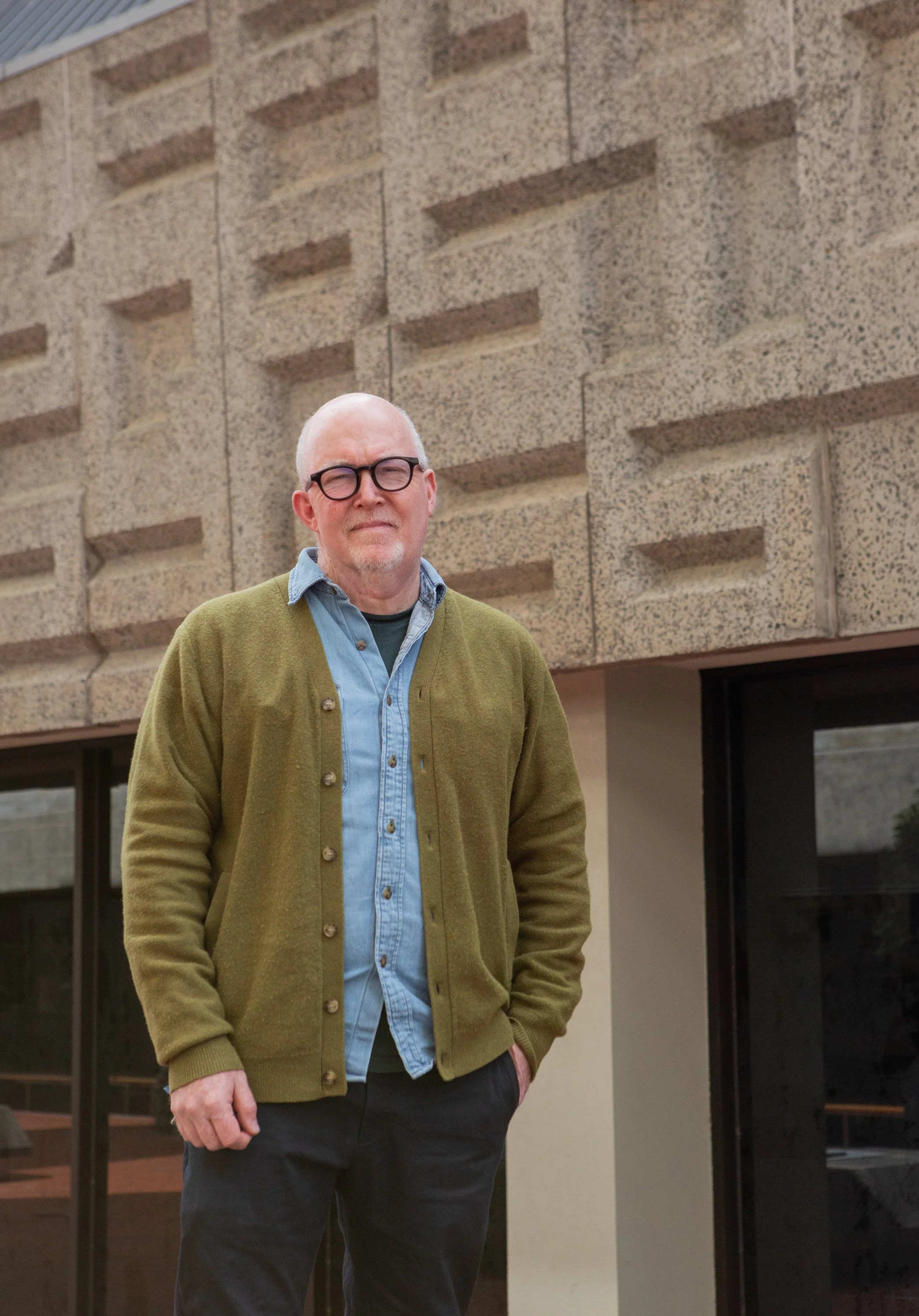
Warren Taylor, graphic designer, lecturer in communication design and founder of The Narrows.
Warren Taylor connects two countries that are very close to me, Italy and Australia. Nominated by Arianna and Tessa Moroder from Lottozero, he became a direct link between Prato and Melbourne. Warren is a graphic designer, a lecturer in Communication Design at MADA (Monash Art, Design and Architecture), and the founder of The Narrows, a curatorial project interested in the convergence of art and design. But first of all, I would describe him as an educator who deeply cares about sharing the practice and history of design, and the world connected to it, with the next generation of designers. His perspective on today’s students, their adaptability and their ability to both engage with and reject current technologies, opens up a conversation about how a new generation of designers might find a balance between the speed imposed by the tech industry and the slower, more community-driven practices that are increasingly emerging around us. It is within this tension that Warren sees potential for the future of design. His deep interest in archives reveals another important part of his personality. For him, the archive is something alive, and his interest lies in the systems behind it, how people document, catalogue and then reactivate what has been collected. For him, it is also a responsible act. It is about creating more inclusive archives that can tell different stories and bring more voices forward. Our conversation is about the importance of stepping outside our usual routines, experiencing new and different cultures and allowing ourselves to be exposed to new perspectives. It is about relationships and conversations, and about the ongoing dialogues between generations that keep us curious, motivated and engaged.
How would you introduce yourself?
I’m a graphic designer and an educator at Monash University. I was born in Malaysia, grew up in Darwin in the Northern Territory and Newcastle in New South Wales. My father was in the Air Force, so we moved around quite a bit. I moved to Melbourne in 1998, so I’ve been here for about 27 years now.
You’re known as a graphic designer and lecturer in Communication Design at Monash Art Design and Architecture. Could you share a few key moments that have shaped your professional journey?
I started working as a sessional lecturer at Monash in 1999, while I was freelancing as an illustrator. I was working mostly on editorial illustration for magazines and newspapers, and through an art director I met Gene Bawden, who was a lecturer at Monash at the time and is now Head of Department.
That was a foundational moment for me. Gene offered me some teaching in the first year, and we’ve maintained a strong working relationship ever since. His support and his belief that someone as young as I was – 25 at the time – could teach at university, really shaped my path. Teaching wasn’t something I had planned, it was a completely serendipitous opportunity.
Later, in 2011, I was offered a full-time position. That marked a big shift, from working independently and teaching part-time, to becoming part of the institution. My role expanded into program development, coordination, and administration.
Another key moment was teaching in Prato, at the Monash campus in Italy. That experience really changed how I thought about pedagogy, especially in an immersive context. It has shaped my approach to teaching ever since.
I was always interested in drawing as a child. I was constantly making things and showing them to people, so there was always this idea of display and communication. But growing up in Darwin, without an artistic background in my family, I didn’t really know what graphic design was. I was drawn to record covers, film titles, signage, but I didn’t have the language for it. It wasn’t until I started teaching illustration that I became more aware of typography, publication design and those foundational practices.
Looking back, being around other practitioners and students was crucial. That’s when I realised that this is what I’m interested in.
How did the experience in Prato change your perspective on teaching?
It was my first time teaching outside Australia and it was immersive, for both the students and myself. Instead of seeing students once a week, we spent several days together, often socialising, having coffee and eating dinner. You’re thinking about design constantly, within a completely different cultural context. Being in Italy, with its deep history in both traditional and radical design, was incredibly stimulating.
When I came back, I started thinking about how to reimagine that model of teaching at Monash. In Prato, students are removed from their usual routines – work, family, relationships – and they can focus on their design practice. It also made me realise how important it is to step outside, physically. I studied in a very analogue period, then moved into the digital era, and now we’re in yet another technological phase. In that context, being in a place like Prato felt essential, it grounded the experience of being part of a design profession.
What has been the greatest challenge you’ve faced in your career, and how did it shape you?
For a period between 2006 and 2011, I was doing three things at once: running my own design practice, teaching part-time and running a small gallery.
That was definitely challenging, balancing all of that and paying the bills, but it was also incredibly formative. When I moved to Melbourne I didn’t know many people, so the gallery became a way to connect with a community.
It shaped how I think about teaching, being embedded in a local cultural context, working with artists, designing publications, supporting exhibitions. It made me think about the broader ecosystem around creative practice.
Let’s talk about The Narrows, the curatorial project you founded. How did it start and what did it aim to investigate?
It really began quite organically. When I first moved to Melbourne, I connected with friends from Newcastle and we organised a group exhibition. That was my first experience of curating and I really enjoyed it. Later, I joined the committee at West Space, an artist-run initiative in Melbourne. That deepened my understanding of how important these spaces are for supporting creative communities. At the time, there weren’t many spaces dedicated to exhibiting graphic design. So I thought, why not create one?
The Narrows became a space to position graphic design alongside contemporary art. I was curious: would artists be interested in exhibiting in a design-focused space? Would design audiences engage with contemporary art? There wasn’t a strict business plan, just a short manifesto and a lot of learning by doing.
One of the early exhibitions came from a friend’s PhD research on jazz producer Joachim-Ernst Berendt. It was quite unconventional, people even thought it was fictional, but it opened up interesting possibilities.
Then I was approached by artists John Nixon and Stephen Bram to exhibit the work of Ronald Clyne, who designed hundreds of record covers for Folkways Records. That exhibition really established the space and connected it to the broader Melbourne arts community.
From there, it evolved project by project, through relationships and conversations.
Education plays an important role in your professional life. What does being an educator mean to you today?
I’ve essentially grown up with teaching, it’s been a constant in my life. What’s interesting is that while I get older, my students stay the same age. Every year, I work with 18- to 20-year-olds, creating an ongoing dialogue across generations that continually exposes me to new perspectives and changing ways of thinking.
The fundamentals of design – thinking, making and communicating – haven’t really changed. But the technologies have and they’ve had a huge impact on how students learn and access information. Institutions are also changing and that creates challenges for educators. At the same time, I’m inspired by students who still come to university with curiosity and passion. That keeps me engaged.
It’s a complex moment, especially when you look at the speed of technological and political change, but there’s still a strong sense of community within the department. We’re navigating these challenges together.
Communication design can feel like a universal language, yet it is also deeply context-specific. What’s your perspective on this?
We’ve actually been thinking about this quite a lot recently through a publishing unit we’re developing, particularly in relation to teaching in places like Milan, Prato and more recently through study tours in Tokyo and across Japan.
This idea of community, of who design is for and where it sits, is really critical. It also works as a kind of counterpoint to the way design is increasingly being globalised and, in some cases, flattened. You can upload a brief to an online platform and receive responses from all over the world, often without much consideration for context or place.
For me, that’s where communication design education still has a really important role to play: in grounding students in both local and international contexts. Australia, for example, has a relatively short history in terms of commercial art and graphic design and only more recently has there been a deeper engagement with Indigenous knowledge and practices that are intrinsically tied to place.
At the same time, we’re part of a global network. I’ve always been inspired by Italian, Swiss, Japanese and British designers and you can clearly see those influences in Australian work. Younger designers today are even more connected, they can share their work instantly, collaborate remotely and operate across borders in ways that weren’t possible before.
But for me, the work that really stands out is the work that has a strong sensitivity to context. Even within this global flow of images and references, you can recognise when something is grounded in a specific place, a specific culture, or a particular way of thinking. That’s what gives it depth.
Working closely with new generations of designers, what excites or intrigues you most about the current design landscape?
It’s a challenging moment for younger designers, particularly in communication design. Over the past 20 years, access to tools has expanded enormously and now, with AI, even more so. There are systems designed to speed things up, to automate processes, to remove certain steps altogether. In some ways that’s exciting, but in other ways it can also compress the learning process.
So I think one of the key challenges for young designers today is understanding where they position themselves. If the tools are accessible to everyone, what defines your practice? How do you find your place, especially outside of an institution?
At the same time, I’m really interested in the return to materiality. You can see it clearly in music: we moved from records to CDs to streaming, but now there’s a renewed interest in vinyl. That desire for something tactile is still very present. I think the same applies to graphic design. There’s a renewed interest in the process and in slowing things down. Not everything needs to be immediate.
What gives me confidence is that students today are incredibly adaptable. They’ve grown up with this technology, so they don’t necessarily see it as a threat. They’re able to engage with it, but also to question it or reject it when needed.
There’s also an interesting tension between speed and slowness. On one hand, you have big tech pushing things forward very quickly. On the other, you see smaller, community-driven practices that are trying to create space for more thoughtful, slower ways of working.
That balance is what I find most compelling and it’s probably where I see the most potential for the future of the discipline.
Your work often engages with the archive as a space of research and creation. What does the archive represent for you, in design and more broadly?
The archive became important to me through teaching and curatorial work. Because I didn’t study design formally, I discovered its history later and that really shaped my appreciation of it.
I’m drawn to the archive not just as a collection of artefacts, but as a system. It’s about preservation, but also about people – how work is documented, catalogued and then reactivated by students, designers, researchers and the general public.
Exhibiting graphic design, though, is always a challenge, because you’re removing it from its original context. A poster on a gallery wall is very different from a poster on the street. At The Narrows, we did an exhibition of posters by Experimental Jetset, a Dutch design group, and from that moment we started showing more and more poster exhibitions. Partly because they were relatively easy to ship and display, but also because they kept raising questions about how we archive work and how we choose to exhibit it.
We later held an exhibition on Les Mason, an American-Australian graphic designer, which was brought to me by Dominic Hofstede. At the time, Dom was running a blog called Re:collection, which covered a gap in documentation of Australian graphic design. That project evolved quite naturally into something bigger. Together with Dom, Paul Mylecharane and Vincent Chan, we developed Re:collection into a more structured archival platform. The idea was to bring together materials from roughly the 1960s to the 1990s, a period before the desktop computer became central to design practice. It’s an ongoing project and one that will probably never be finished. We’re constantly collecting – from markets, op shops and eBay. It’s as much about chance encounters as it is about research. We’ve also had conversations with institutions like the State Library and the National Library, thinking about how these materials might be preserved in the long term. I think in 30 or 40 years, this kind of work will become an important record of a particular moment in Australian design.
There’s also a responsibility that comes with it. That period, for example, is often dominated by male designers, but as we’ve looked more closely, we’ve found many important female practitioners who were either overlooked or working in the background. So part of the work is about bringing those voices forward, and making the archive more inclusive.
Is there a project you still dream of realising, something that, for some reason, hasn’t yet taken shape?
There are always many!
One project I’ve been thinking about for a long time focuses on Gianni Sassi, an Italian designer, artist, curator, educator, and editor. I first discovered his work through music, as he started a record label called Cramps and I became really fascinated by his multidisciplinary practice.
There isn’t much written about him in English, so I’d like to develop an exhibition and a publication to bring his work to a wider audience.
Could you name a person who inspires you or someone you admire?
I think Yusuke Oono is a genius, and his work deserves far greater visibility. He is the founder of Domino Architects, though his practice extends well beyond architecture. There is a remarkable complexity to his projects, yet they remain accessible, thoughtful, and deeply connected to the community.
Over the past two years, Oono-san has worked with my students in Tokyo, leading fieldwork through careful observation and engagement with local contexts. He made me think deeper about the way I approach my own work, my life and my family.
