

Lottozero
Ph. Rachele Salvioli
Stranger #14
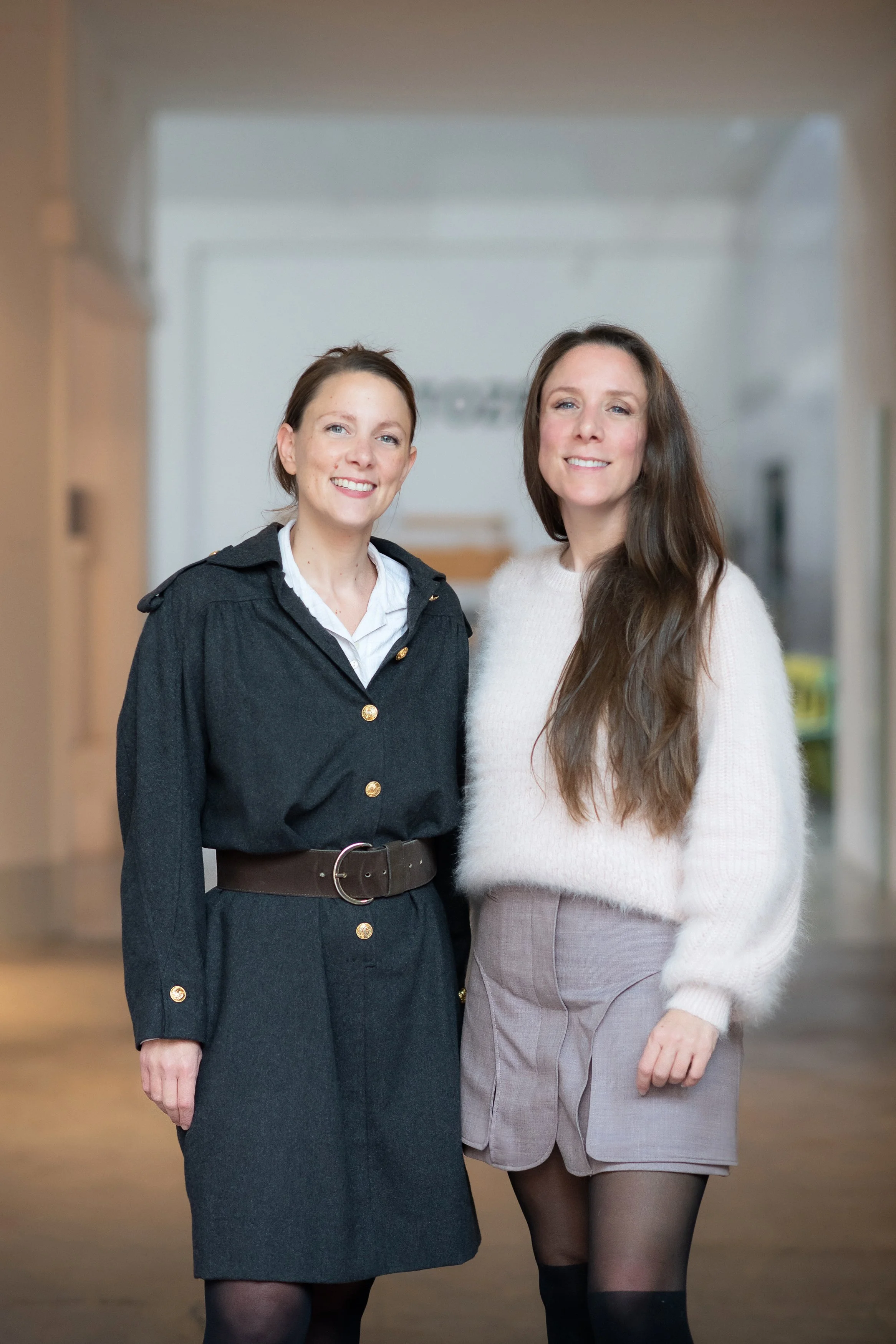
Arianna and Tessa Moroder, Founders of Lottozero
Arianna and Tessa Moroder are the sisters, creators and driving force behind Lottozero. I want to underline the fact that they are sisters, because this is something that stayed with me after speaking with them. Throughout our conversation, I strongly sensed their sisterhood – a deep bond built on mutual support and shared commitment along their journey. Choosing to build a project like Lottozero was far from the easiest path they could have taken. Both Arianna and Tessa could have continued their lives elsewhere, in countries where they were already beginning to develop their individual careers. Instead, they chose a different direction: to reconnect with the local fashion and textile system in Prato – a city in north-eastern Tuscany historically known as one of Europe’s most important textile hubs – and to share this knowledge with a new generation of designers and creatives. Driven by passion and determination, they transformed their grandfather’s old warehouse into a sophisticated and forward-thinking textile and cultural hub – one of the first of its kind in Italy. They were never afraid of not being fully understood. As they say, if they haven’t yet reached their full potential, it simply means there is still more work to do and more people to involve. From the very beginning, Lottozero’s goals have been clear, and their commitment to the project is truly admirable. In this interview, Arianna and Tessa share the story of Lottozero, the challenges they faced, and the achievements that led to the creation of a wide national and international network they have patiently built over time.
How would you introduce yourselves?
A: I’m an artist, a textile designer and the co-founder of Lottozero.
T: I’m the co-founder and ceo of Lottozero.
What were the key moments that led you to where you are today?
T: I studied economics and, right after graduating, I had, or rather, I felt that the world had certain expectations of me: a fast and brilliant career. During high school and university, my dream was to become a film producer.
I was recruited by the Fiat Group and immediately entered a very corporate system, in Turin, a city that can feel quite strict. One of the most crucial moments for me was realising that this was not the life I wanted. After less than two years, I resigned and travelled for a year.
That experience helped me understand that I wasn’t made for the corporate world, and that my interest in film production was really about making things happen with the means available, about enabling things to happen efficiently. From there, I began a path made up of small, adaptive steps within the cultural and creative fields. That journey gave me the courage and strength to build Lottozero together with Arianna.
A: For me, there are three key moments, all connected to quite difficult personal experiences.
The first goes back to when I expressed the desire to study fashion. My father suggested I move to London, but at eighteen I was too shy to take that step. I stayed in Italy, close to the Italian production system, and that choice deeply shaped my path.
The second moment was my mother’s illness and then her passing. At the time I was living in Germany and planning to stay there, but I started returning home more and more often. After her death, my permanent return, together with the availability of a space, marked the beginning of everything.
The third moment came during a period of discouragement, when I felt I wasn’t good enough or suited to pursue an artistic career. I thought perhaps my role was to support others instead. I remember exactly where I was when I called Tessa and said, “Okay, let’s really do this project.” The idea was still very embryonic, but that was when Lottozero truly began to take shape. These were difficult experiences, but they ultimately generated something deeply positive.
What has been the biggest challenge you’ve faced so far?
A: I would simply say covid. It was the hardest thing we’ve faced: seeing a space designed to be alive, full of people, activity, and energy, completely empty. And wondering whether we would be able to come through it intact.
T: When I’m inside a difficult moment, everything feels enormously complex, but as soon as I’m out of it, I tend to forget how hard it actually was. Right now, I don’t feel like there’s one major challenge in particular, so everything almost feels easy.
We live in a constant state of learning by doing: you learn from mistakes, and the next time you do things differently. Sometimes it would be nice to do learning by learning first, but this is the path we’ve chosen. For me, the biggest challenge is always the next one.
Arianna, how did you navigate the pandemic period?
A: At the time, we were much smaller as an organisation. If it were to happen today, it would probably be even more difficult. I have to admit that I’ve almost removed that period from my memory – the lockdowns, the closures, the rules, the schedules.
For a space that lives on collaboration and co-existence, it was extremely hard. I clearly remember a deep sense of sadness. We held on, organised many online activities, and rethought a lot of our strategies. In a way, we also simplified things, focusing more on what was truly important.
Lottozero was founded as one of the first cultural hubs dedicated to textiles in Italy. How would you describe its evolution over the years?
T: At the beginning, we were among the first not only in Italy, but also in Europe. We visited a few existing examples in order to learn from them, but there were very limited references available.
In reality, what Lottozero is today does not differ much from our initial business plans. We were fortunate to win the Culturability call quite early on, which, in addition to a financial grant, offered a training programme focused on the management of regenerated spaces. This allowed us to analyse our activities and business model in depth.
What has changed, in my opinion, is who has embraced the opportunity we created: not always the people, clients, or companies we originally expected.
A: Aside from growth and consolidation, the original idea has remained surprisingly consistent.
T: We did not expect, for instance, such a strong interest from the art world, especially when it came to residencies. We anticipated more requests from fashion and design, but instead the art world quite literally flooded in.
This was also a positive development, particularly because in those years textile art, as we have always understood it, began to enter the mainstream of contemporary art. We took part in and contributed to this process of legitimisation, while also being part of broader global movements that brought unexpected connections and collaborations.
A: We have always imagined Lottozero as a very broad and permeable container, with space for many different things.
T: Perhaps a more challenging aspect has been the limited involvement of Italian companies compared to those from abroad. Partly because we are not originally from Prato and are perceived as “outsiders.” We expected a stronger engagement from the Italian fashion and textile system, whereas most of the interest has come from outside Italy.
What do “quality” and “innovation” mean to you today?
A: Quality is a term we reflect on a lot, especially because we work closely with production and manufacturing. To me, quality is similar across every field: it is a concept, an idea, or a product that has been thought through in depth, examined from every point of view. Something that has a reason to exist, that is grounded, tangible, with a beginning, a development and an end.
Innovation, on the other hand, is more difficult to define.
T: Innovation has become such an overused word that it now feels almost empty. The concept I have found most interesting for years is cross-innovation: innovation that emerges from the encounter between sectors that do not normally interact. This is also our strength.
For us, innovation means finding creative, artistic, and cultural solutions to real problems in other fields. This is the most stimulating part: using art, culture, and design to respond to concrete needs.
From the very beginning, you brought an international approach to textiles and project culture to Prato. How was Lottozero received at the start, and how has your relationship with the local community changed over time? What actions have you taken to involve it?
A: As Tessa was saying, we expected a bit more feedback from local stakeholders. Recently, however, something has started to change: even just hearing someone say “I know who you are, I know what you do” already feels like a big step forward.
With the international community, on the other hand, I never had any doubts. Prato is an extremely interesting place for anyone working in textiles. I had no difficulty moving here and I have no regrets. Anyone who approaches this world is fascinated by the omnipresence of textiles –it’s something I’ve never found anywhere else. The potential is enormous. I continue to promote Prato, to talk about it, to invite people to come and discover it. Those who arrive always find a different reason to fall in love with it.
T: I think today the time is simply more mature for what we do. Our approach hasn’t changed: we host events in the space, public events, courses, ticketed initiatives, and we organise at least three exhibitions a year, often four or five, with openings, parties, and more open events.
Ten years ago, when we talked about a creative hub dedicated to textiles, in Italy no one really understood what we meant. Today the topic is more widely accepted. So we’ll probably start doing even stranger things now, just to go back to not being understood (laughs). It’s a matter of timing.
Lottozero would not have been possible anywhere else: we are deeply dependent on the textile district. We often talk about a community lab, because beyond our internal machinery we have built a network of relationships with local companies that makes this model possible.
When we presented the project in Northern European countries, its potential was immediately understood. In Italy, perhaps we haven’t yet reached our full potential and that’s fine. It means we still have a lot to do and many people to involve.
When we talk about community, we mean a sector-specific community, people working in textiles, textile art and fashion. We are not a space for general-purpose events. There are already many of those in Prato, including in the textile field. Our engagement is aimed at stakeholders, even though of course a neighbour might come to see an exhibition, but not to use the machinery.
Prato is historically one of the most important textile districts in Europe, but also a complex and constantly evolving territory. What is Prato like today and how do you see its future?
A: Prato is at a crossroads. Traditional productions, especially those linked to wool regeneration are going through major difficulties. These are almost old and traditional processes that struggle to survive for a series of complex, interconnected reasons. They would need much more support, including from public institutions.
At the same time, there is a very active area of research and innovation, attentive to what is happening globally and highly responsive. It’s as if several parallel lives coexist and intersect in an extremely dense place, with many different approaches. Many things will change, some companies will close, but new ones are being born. Prato is a place in constant motion, anything but static.
T: It’s interesting to note that only this year has the service sector overtaken manufacturing. Ideally, Prato would still be a manufacturing city, but within a European context this is quite a unique situation. It is also the Italian city with the highest percentage of immigrants, around 25% and is therefore extremely international.
From a sociological point of view, Prato is almost an ideal city for Italy: it’s a provincial city, but very accessible, close to Florence and on the Milan–Rome axis. It offers a high quality of life, like many Tuscan cities, thanks to long-standing policies on healthcare, childcare, and women’s employment, for example. It’s an efficient city, a model for many other Italian realities.
Education is an integral part of your work and of Lottozero’s DNA. What is the relationship of younger generations with textiles today? Do you notice differences between Italy and other countries?
A: In Italy we are in a particular situation: we have many textile industries, but relatively little education, both in design and in technical professions. In other European countries the opposite happens: there is a lot of education but little production.
This also stems from traditional systems that connect education and work. In Italy, moreover, for decades the textile sector has been described as failing, creating discouragement among younger generations. Companies often don’t know where to turn to renew their workforce. Something is changing, though. I see curiosity among younger generations, and we try to nurture it by showing what happens behind the scenes, how rich and full of potential this world really is.
You launched Lottozero in 2016 also thanks to a crowdfunding campaign. How did the idea come about, and how did you build that campaign? Do you think it would still work today?
T: Crowdfunding was mainly a promotional tool, because with €12.000 you certainly don’t launch a project like Lottozero. The campaign worked in two ways: we exceeded our goal and, above all, we gained a lot of visibility. Looking back years later, we realised that everything we promised was actually delivered, which is quite rare. It was a fun and important project.
A: At the time it was the era of Kickstarter and crowdfunding. Today I think perceptions have changed: they still exist, but they’re no longer as appealing.
T: It allowed us to create an international community from the very beginning. We had supporters from all over the world, even from Japan: one of them actually came to the opening. It also gave us local visibility thanks to Verde di Prato, the scarf collection designed by Arianna and entirely dedicated to Prato.
In recent years, art and fashion have grown much closer. How do you read this relationship today?
T: For us it’s a complex relationship. Because we work in both fields, we struggle to position ourselves. In our experience, it’s not really true that art and fashion have genuinely come closer, except for a few very famous collaborations. Keeping fashion, industry and art under the same roof creates a lot of confusion.
A: I agree. Perhaps they have come closer at the level of communication. Art looks more toward fashion, and “being part of the art scene” has become fashionable. But in the fashion business, this closeness is not so evident. It’s more of a media narrative.
T: In Italy, fashion is considered industry and manufacturing, whereas in the rest of Europe, France aside, it falls within the cultural and creative industries. This is complicated for us, because abroad it’s clear that we operate in the cultural sector, while in Italy categories are more rigid.
On the other hand, it also means that the fashion industry still exists here. We should be careful not to lose it, so as not to end up like other countries that are now trying to rebuild it.
Sustainability in fashion is a very current and widely discussed topic, but it is often reduced to superficial initiatives. What is your vision? And how does the Lottozero Circular Wool Lab fit into this conversation?
A: I see two levels. On one side, industry, which needs to improve concretely in terms of emissions, processes and technology. On the other, education and training for designers, creatives and also a broader public. Talking about products, consumption and alternative models.
The Circular Wool Lab addresses materials, short supply chains, and circular processes. It works with local wools that would otherwise be waste, creating value and a reason for these materials to exist. It’s a niche, research-based project, but with multiple outputs: the product and above all, the awareness it generates: education and information. It’s a project that has accompanied us from the very beginning.
T: It’s a love–hate project: complex, difficult, often without adequate funding and with little commercial return. It’s extremely idealistic, like many of our projects. We started talking about it ten years ago, when the topic was not yet widespread. Today it has finally become central. The Lab allows those who want to experiment with these wools to do so, providing tools and expertise.
Is there a project you still dream of realising that, for some reason, hasn’t yet taken shape? If so, what is it?
T: We have a very long list (laughs). Among the ongoing projects is our Directory, a website that brings together a curated selection of sustainable Italian brands. It was born during Covid, using funds we had received for a physical event. It already makes sense as it is and we keep it updated, but it could be developed much further.
The most ambitious project, however, is the creation of a rural hub in the valley between Prato and the Tuscan-Emilian Apennines: a micro-factory that follows the entire supply chain, from fiber to garment, in a town of 6.000 inhabitants. A rural regeneration project.
Could you name a person who inspires you or someone you deeply admire?
A: We would like to name Warren Taylor, designer and lecturer at Monash University. We met Warren at the Prato site and he immediately believed in us. With his extensive experience in screen printing, he supported and inspired us profoundly.
“Dear Warren,
Lottozero would like to nominate you for this interview, as you were one of our very first Australian connections here at Lottozero. You believed in us from the beginning and clearly saw our vision, even when there was still so much to build.
Thank you for inspiring us and for sharing your knowledge with such openness.”
